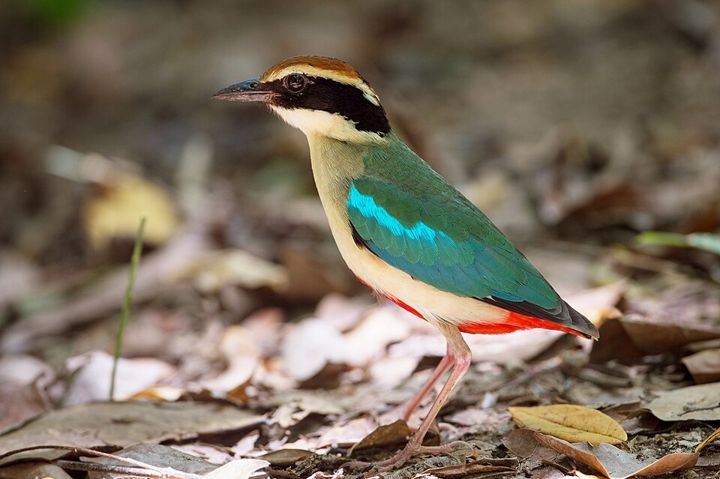
Photo: Jason Thompson from Bangkok, Thailand, via Wikimedia Commons, licensed CC BY 2.0. Unmodified apart from resizing.
Region
Japan and temperate East Asia, Singapore and tropical Asia
Habitat
forest
Colour
green, blue, red
Size
small (under about 20 cm)
IUCN status
Vulnerable
IOC breeding range
OR, PAL (Honshu, Shikoku and Kyushu (s, c Japan), Jeju (s of Korean Pen.), s, e China and Taiwan)
IOC non-breeding range
to c Borneo
Identification
A small, brightly coloured passerine, 16–19.5 cm long and about 90 g, in seven colours like a rainbow: chestnut crown, broad black eye-stripe, buff brow, green back and wings, cobalt lesser coverts, sky-blue rump; cream below with a red lower belly and undertail; dark green tail tipped cobalt, yellowish-brown legs. White patches on the black primaries show in flight. It hops on the forest floor.
Habitat
Subtropical broadleaf forest, bamboo, plantations and stream valleys in low hills, turning the leaf litter for earthworms, spiders, insects, slugs and snails; builds a domed nest of twigs and moss on or near the ground.
Distribution
Breeds on Honshu, Shikoku and Kyushu in Japan, on Jeju in Korea and in southern and eastern China and Taiwan; winters in Borneo. Rare and declining through deforestation, fire, hunting, trapping and the cage-bird trade; listed as vulnerable. Recorded on passage in Singapore.
Season and behaviour
Breeds in south-east China, Taiwan and Japan from May to August, calling a two-note whistle most at dawn in May and June; occasional passage birds in Singapore in October–November and April.
Photography tips
These are the FilmAnalysis editors' notes, not content from the sources.
Understorey light is very weak: high ISO, a wide aperture and 1/320 s; it hops a few steps and pauses, and that is the moment. The colours are truest in soft overcast light, while direct sun makes blotchy highlights. In the breeding season it is extremely sensitive to disturbance: keep away from nests, no playback, and do not wait long.
Field ethics: keep a distance at which the bird does not change its behaviour; never approach or publish nest sites; no baiting, playback or flash; never clear vegetation around a nest; follow reserve rules and stay on paths.
Photographic styles
A seven-coloured bird in forest shade; saturated colour in low light.
Similar species
Blue-winged pitta (more blue in the wing, blackish-brown crown, South-East Asia); hooded pitta (green breast, passage in Singapore).
Related badge
None yet. No validated photo recognition exists for this species, so no badge is tied to it: a name in the encyclopedia is not evidence in a photograph.
The illustration is original FilmAnalysis artwork. The photograph is from Wikimedia Commons; its licence and author are under it.