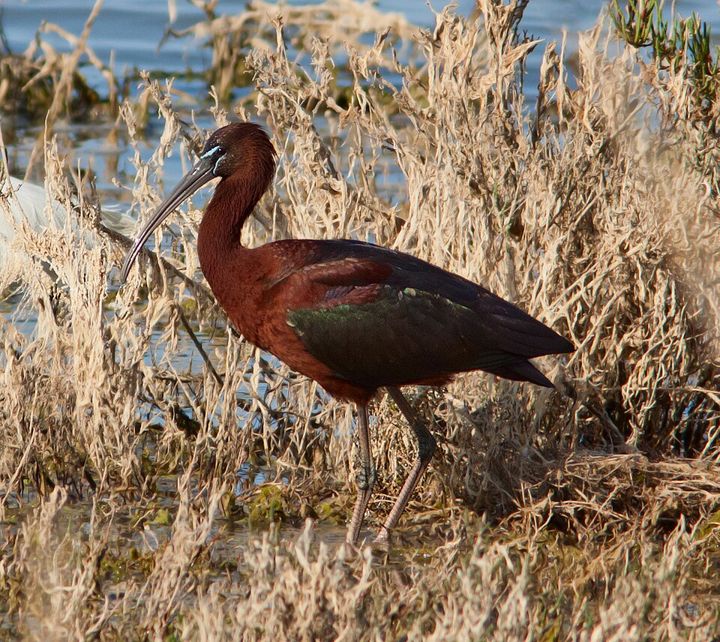
Photo: Gabriele Iuvara (derivative work: MPF), via Wikimedia Commons, licensed CC BY-SA 2.0. Unmodified apart from resizing.
Region
Singapore and tropical Asia, Japan and temperate East Asia
Habitat
rivers and wetlands
Colour
brown, green, purple
Size
medium (20 to 50 cm)
IUCN status
Least Concern
IOC breeding range
Worldwide but disjunctly (s Europe, Sub-Saharan Africa, Madagascar, c, s Asia to Philippines, Sulawesi, Java and Australia; also e and Gulf coasts of N America, Caribbean and n Venezuela)
Identification
A medium-sized ibis with a long sickle-curved bill, from which the scientific name (Greek and Latin for sickle) comes. Nearly black at a distance, close up a deep chestnut head, neck and body with wings glossed green and purple; in the breeding season fine pale blue-white lines edge the bare face. Non-breeders have fine white streaks on the head and neck. Long legs; it flies with neck and legs extended, often in lines.
Habitat
Shallow fresh and salt wetlands: marshes, paddies, lake edges, estuaries and fish ponds, probing the mud with the long bill for aquatic insects, crustaceans and small fish; nests colonially with herons in reeds or bushes.
Distribution
The most widespread ibis, breeding in scattered sites in the warm regions of Europe, Asia, Africa, Australia and the Americas; most European birds winter in Africa, and it is resident in western India. Records in southern and eastern China have increased in recent years, with appearances and some breeding in Yunnan, Guangdong and Jiangxi; a rare vagrant to Japan and Singapore.
Season and behaviour
In southern and eastern China mostly from April to October, with recent breeding records in Jiangxi and Yunnan and a few wintering in the far south; a single glossy ibis often draws birders.
Photography tips
These are the FilmAnalysis editors' notes, not content from the sources.
It looks black from afar and the metallic sheen appears only in front or side light, best in low evening sun, half a stop under to keep the shadows. The probing pose in shallow water and the sickle bill are the point, from low down with a long lens. A line flying past against the dusk sky is the other picture.
Field ethics: keep a distance at which the bird does not change its behaviour; never approach or publish nest sites; no baiting, playback or flash; never clear vegetation around a nest; follow reserve rules and stay on paths.
Photographic styles
Near-black metallic sheen on a wetland; a flight line at dusk.
Similar species
White-faced ibis (Americas, white border to the face when breeding); red-naped ibis (bare head, white shoulder patch, South Asia); from afar like a young night heron or small stork, told by the downcurved bill.
Related badge
None yet. No validated photo recognition exists for this species, so no badge is tied to it: a name in the encyclopedia is not evidence in a photograph.
The illustration is original FilmAnalysis artwork. The photograph is from Wikimedia Commons; its licence and author are under it.