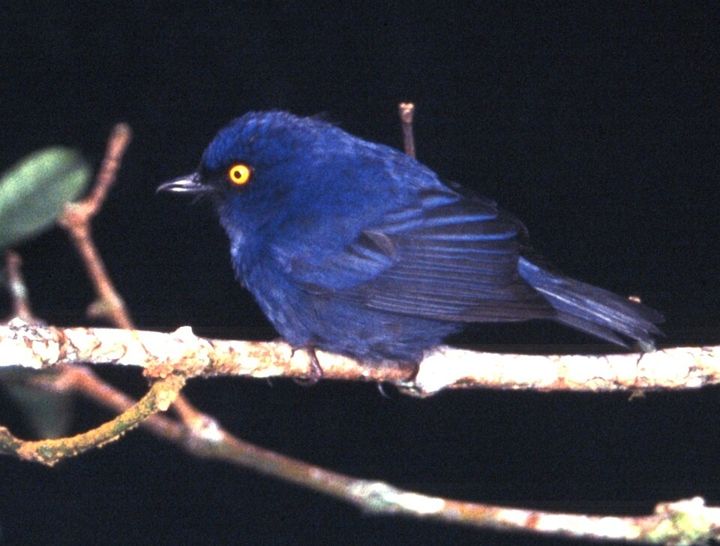
Photo: Chrystopher Canaday, Aves y Conservación, via Wikimedia Commons, public domain / CC0. Unmodified apart from resizing.
Region
Elsewhere (in East Asia only in bird parks or botanic gardens)
Habitat
forest
Colour
blue, yellow, black
Size
small (under about 20 cm)
IUCN status
Least Concern
IOC breeding range
SA (Colombia to Bolivia)
Identification
A small tanager, deep blue, and the only flowerpiercer with bright yellow eyes, hence its other name deep-blue flowerpiercer. The bill is hooked upward at the tip, used to pierce the base of flowers and steal nectar without pollinating them, a habit of the whole genus.
Habitat
Humid Andean montane forest and forest edge, moving among flowering shrubs.
Distribution
The Andes of Colombia, Ecuador, Peru and Bolivia. Absent from East Asia and rarely in bird parks; Birdwatching Notebook lists it as an exotic.
Season and behaviour
Resident, seen all year within its range.
Photography tips
These are the FilmAnalysis editors' notes, not content from the sources.
Photographing it in Andean cloud forest depends on luck and flowers: wait by a flowering shrub with high ISO and 1/1000 s. A deep blue bird in dark understorey is nearly black, and the yellow eye is the one bright point to focus on. No playback.
Field ethics: keep a distance at which the bird does not change its behaviour; never approach or publish nest sites; no baiting, playback or flash; never clear vegetation around a nest; follow reserve rules and stay on paths.
Photographic styles
A deep blue bird in cloud forest; the single bright point of a yellow eye.
Similar species
Other flowerpiercers (dark eyes, different blues).
Related badge
None yet. No validated photo recognition exists for this species, so no badge is tied to it: a name in the encyclopedia is not evidence in a photograph.
The illustration is original FilmAnalysis artwork. The photograph is from Wikimedia Commons; its licence and author are under it.