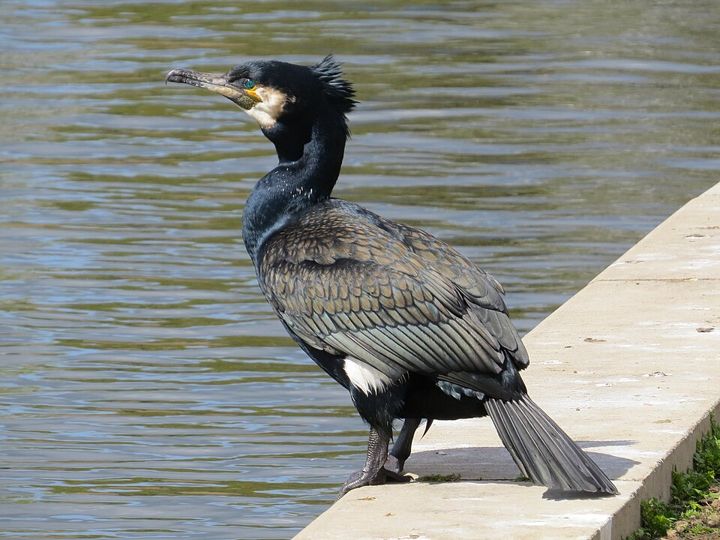
PAL, AU, OR, NA, AF (worldwide in temperate and tropical zones, coastal and inland, except in Western Hemisphere where nw North Atlantic coast only.)
Identification
A large waterbird, 70–102 cm long with a wingspan of 121–160 cm, varying greatly in weight between subspecies. Black with a bronze-green sheen, yellow bare skin at the bill base and cheek bordered white below; in the breeding season white filoplumes appear on the head and neck and a white patch on the thigh. The long heavy bill is hooked. It stands on posts, rocks and branches with the wings spread to dry.
Habitat
Sea cliffs, estuaries, lakes, reservoirs and large rivers, increasingly inland; nests colonially on cliffs or in trees, laying three to four eggs.
Distribution
Across the temperate and tropical Old World, Australasia and the Atlantic coast of North America. Common on coasts and large inland waters in China and Japan, with big winter numbers; scarce in Singapore.
Season and behaviour
Seen all year in eastern China and Japan, with wintering flocks from the north reaching hundreds or thousands. After diving for fish it must come out to dry its wings. The cormorant fishing on the Nagara River in Gifu uses the related Japanese cormorant.
Photography tips
These are the FilmAnalysis editors' notes, not content from the sources.
The wing-drying pose is the classic picture and backlight gives the clearest outline; evening flights to the roost compress into a line with a long lens. Black plumage blocks up easily: meter on the bird and pull back a little to keep the bronze-green sheen. Dead trees and posts by reservoirs are their fixed perches.
Field ethics: keep a distance at which the bird does not change its behaviour; never approach or publish nest sites; no baiting, playback or flash; never clear vegetation around a nest; follow reserve rules and stay on paths.
Photographic styles
Black silhouettes and geometry; waterside solitude.
Similar species
Japanese cormorant (slightly smaller, different shape to the yellow face patch, coasts of Japan and Korea); pelagic cormorant (smaller, steep forehead, East Asian coasts).
Related badge
None yet. No validated photo recognition exists for this species, so no badge is tied to it: a name in the encyclopedia is not evidence in a photograph.
The illustration is original FilmAnalysis artwork. The photograph is from Wikimedia Commons; its licence and author are under it.