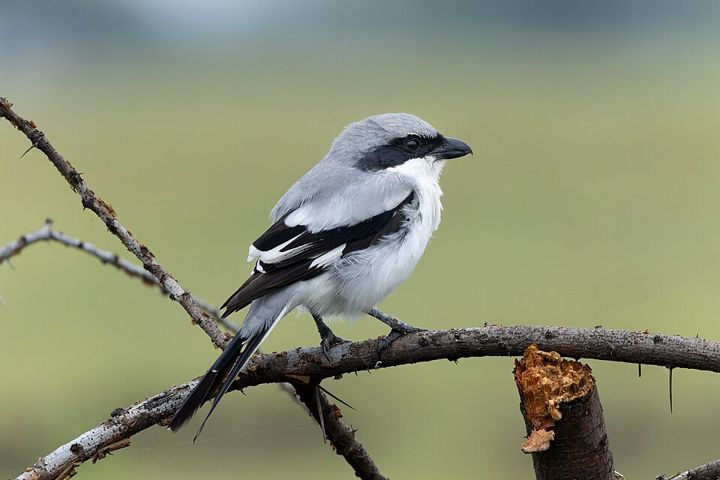
A large shrike the size of a big thrush, 22–26 cm long, about 60–70 g, wingspan 30–36 cm. Sexes alike: pearl-grey above (tinged brownish in the east), a deep black mask through the eye, white cheeks, chin and a thin brow, white below; black wings with white patches, a long black tail edged white. A strong hooked bill. It perches high on exposed twigs and wires watching for prey.
Habitat
Open woodland, clearings, bushy steppe and farmland from plains to hills, needing open hunting views and thorny bushes, on which it impales and stores prey. Carnivorous, chiefly rodents, also small birds, lizards and large insects.
Distribution
Breeds roughly north of 50°N in northern Europe and Asia, most populations moving south to temperate regions in winter; in China seen in Ningxia, Gansu and Xinjiang in the north-west and rarely in the east; a scarce winter visitor to Japan; absent from Singapore.
Season and behaviour
Easiest in north-west China from October to March on wires and treetops; breeds in the north from May to July. Hovering to hunt and impaling prey on thorns are typical.
Photography tips
These are the FilmAnalysis editors' notes, not content from the sources.
It perches high and sees far, usually spotting you first: use a car as a hide along the wires. The grey, white and black is softest on an overcast day and the black mask sharpest in front light. Hovers and stoops need 1/2000 s. Prey on a thorn is a documentary subject, not one to avoid.
Field ethics: keep a distance at which the bird does not change its behaviour; never approach or publish nest sites; no baiting, playback or flash; never clear vegetation around a nest; follow reserve rules and stay on paths.
Photographic styles
Grey silhouettes on wires and twigs; a clean three-colour scheme.
Similar species
Chinese grey shrike (common in northern and eastern China, larger white wing patch, longer tail, mask not meeting over the forehead); other members of the grey-shrike complex do not overlap in range.
Related badge
None yet. No validated photo recognition exists for this species, so no badge is tied to it: a name in the encyclopedia is not evidence in a photograph.
The illustration is original FilmAnalysis artwork. The photograph is from Wikimedia Commons; its licence and author are under it.