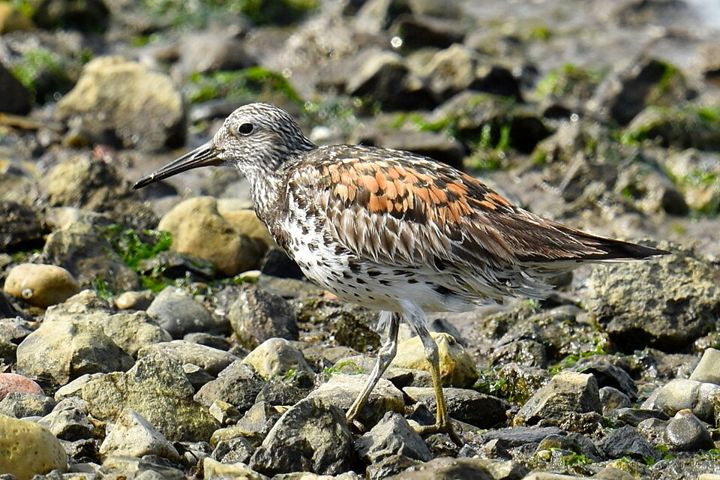
Photo: Original: tcager; this edit: User:MPF, via Wikimedia Commons, public domain / CC0. Unmodified apart from resizing.
Region
Singapore and tropical Asia, Japan and temperate East Asia
Habitat
coast and mangroves
Colour
grey, white, black
Size
medium (20 to 50 cm)
IOC breeding range
PAL (low Arctic and subarctic montane tundra: ne Siberia from Yakutsk e to Anadyr Pen.)
IOC non-breeding range
OR, AU : coastal Australasia: ne Arabian Pen., coastal s, se Asia, Indonesian Arch., Taiwan, se China, Philippines, nw, s New Guinea, Australia including Tasmania
Identification
One of the largest Calidris sandpipers, a medium-sized wader with a longish straight bill drooping slightly at the tip. In breeding plumage dense black spotting forms a black breast band and the scapulars carry chestnut patches; in winter grey above and white below with fine spots. The rump is white in flight. Often with bar-tailed godwits and red knots.
Habitat
Breeds on montane tundra in north-east Siberia, laying about four eggs in a ground scrape; outside the breeding season almost wholly coastal, on intertidal mud, sand and estuaries, gathering on high-tide roosts.
Distribution
Breeds from Yakutsk east to the Anadyr Peninsula; winters on the coasts of South and South-East Asia, the Indonesian archipelago, Taiwan, south-east China, the Philippines and Australasia, in enormous flocks in northern Australia. China's Yellow Sea coast is the most important staging area on the East Asian–Australasian Flyway; passage birds reach Singapore.
Season and behaviour
On the Chinese coast in April–May and August–October, in Japan mainly in autumn; small numbers in Singapore from September to April. The Yellow Sea flocks are a global conservation focus.
Photography tips
These are the FilmAnalysis editors' notes, not content from the sources.
On the flats they are distant: a long lens and a rising tide, which pushes the flock to the shore. The breeding-plumage breast band of spring passage is the point, and side light separates the black spots from the chestnut scapulars. For flocks in flight use 1/2000 s and a slightly wider lens for the shape of the whole. Never flush a flock to make it fly.
Field ethics: keep a distance at which the bird does not change its behaviour; never approach or publish nest sites; no baiting, playback or flash; never clear vegetation around a nest; follow reserve rules and stay on paths.
Photographic styles
Flock pictures and horizons on the flats; grey-white minimalism.
Similar species
Red knot (slightly smaller, shorter bill, brick-red below in breeding plumage); bar-tailed godwit (much larger, long upturned bill); in winter told from other grey sandpipers by size and bill shape.
Related badge
None yet. No validated photo recognition exists for this species, so no badge is tied to it: a name in the encyclopedia is not evidence in a photograph.
The illustration is original FilmAnalysis artwork. The photograph is from Wikimedia Commons; its licence and author are under it.