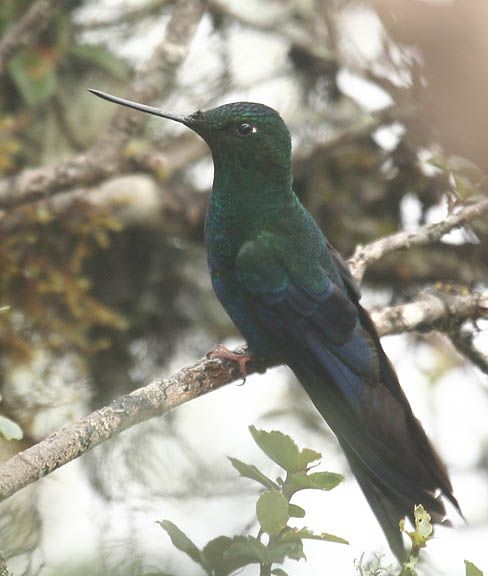
Photo: Michael Woodruff from Spokane, Washington, USA, via Wikimedia Commons, licensed CC BY-SA 2.0. Unmodified apart from resizing.
Region
Elsewhere (in East Asia only in bird parks or botanic gardens)
Habitat
forest
Colour
blue, green
Size
small (under about 20 cm)
IUCN status
Least Concern
IOC breeding range
SA (Colombia to n Bolivia)
Identification
One of the largest hummingbirds, exceeded only by the two Topaza species and the giant hummingbird: 15.5–19 cm long including the 3.6 cm bill, males 9.6–11.2 g and females 8.4–11 g. Both sexes have a small white spot behind the eye. Nominate males are dark shining blue-green above with a mostly shining blue wing, a greenish-black tail and bluer blue-green underparts; females are metallic green above with a dusky grey crown, blue only on the wing coverts, a greenish-black tail with much white on the outer feathers, and cinnamon underparts mixed with green.
Habitat
Semi-open tall woodland and forest edge high in the Andes, feeding on nectar; resident. A relatively slow hummingbird whose wingbeats can be seen.
Distribution
The Andes of Colombia, Ecuador and Peru to northern Bolivia. Absent from East Asia; Birdwatching Notebook lists it as an exotic.
Season and behaviour
Resident, seen all year within its range.
Photography tips
These are the FilmAnalysis editors' notes, not content from the sources.
Larger and slower than other hummingbirds, so 1/2000 s catches the blue fan of the wing; front light is the condition for the blue to appear. Wait beside an Andean feeder and use a wide aperture to push the forest behind into darkness.
Field ethics: keep a distance at which the bird does not change its behaviour; never approach or publish nest sites; no baiting, playback or flash; never clear vegetation around a nest; follow reserve rules and stay on paths.
Photographic styles
A big hummingbird with blue wings; a flash against a dark background.
Similar species
Other large hummingbirds (wings not wholly shining blue).
Related badge
None yet. No validated photo recognition exists for this species, so no badge is tied to it: a name in the encyclopedia is not evidence in a photograph.
The illustration is original FilmAnalysis artwork. The photograph is from Wikimedia Commons; its licence and author are under it.