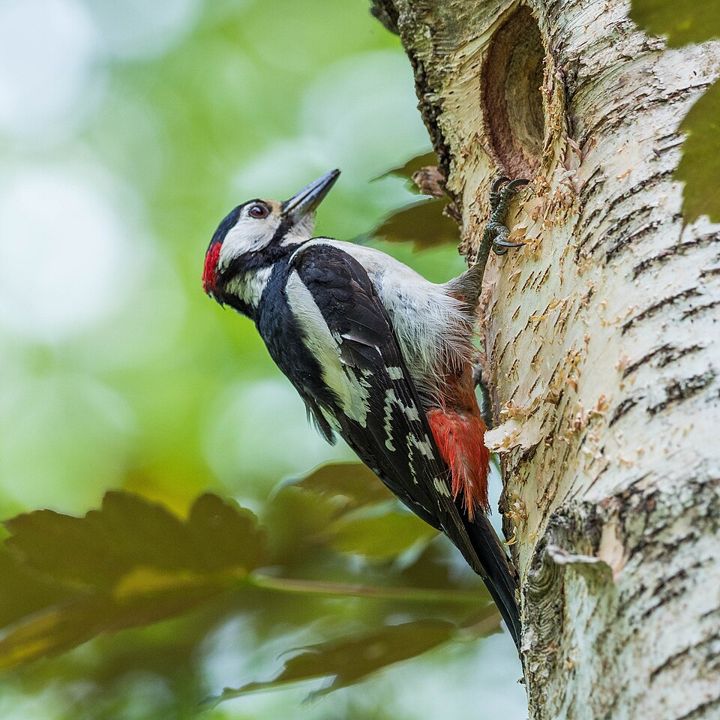
Photo: Bengt Nyman from Vaxholm, Sweden, via Wikimedia Commons, licensed CC BY 2.0. Unmodified apart from resizing.
Region
Japan and temperate East Asia
Habitat
forest, towns and gardens
Colour
black, white, red
Size
medium (20 to 50 cm)
IUCN status
Least Concern
IOC breeding range
PAL (widespread)
Identification
20–24 cm long, wingspan 34–39 cm, 70–98 g. Glossy blue-black above with white face and neck sides and black lines from the shoulder to the nape, the bill base and the breast sides; a large white shoulder patch, black-and-white barred flight feathers and tail; white below with a scarlet lower belly and undertail. Slate-black bill, greenish-grey legs, deep red eye. The male has a crimson nape patch the female lacks; juveniles have a red crown.
Habitat
Woodland of all kinds, parks and gardens with big trees; excavates a nest hole in a trunk, drums fast on wood in spring to claim territory, and visits feeders for peanuts and suet.
Distribution
Across the Palearctic including parts of North Africa; mostly resident, moving south from the north when the cone crop fails. Common from north-east and northern China to central China and throughout Japan; absent from Singapore.
Season and behaviour
Resident, seen all year. Drumming from January to April is the easiest clue to find it; from April to June the parents come and go constantly at the nest hole. In winter it joins tit flocks.
Photography tips
These are the FilmAnalysis editors' notes, not content from the sources.
Listen for drumming, then look for a hole with fresh chippings; wait at 45 degrees to the entrance for the adults returning with food, when front light makes the red belly and black-and-white sharpest. The vertical trunk suits a portrait frame; never trim branches round the hole or stand so close that the bird will not return.
Field ethics: keep a distance at which the bird does not change its behaviour; never approach or publish nest sites; no baiting, playback or flash; never clear vegetation around a nest; follow reserve rules and stay on paths.
Photographic styles
Graphic black, white and red; vertical compositions on a trunk.
Similar species
White-backed woodpecker (larger, white lower back, streaked flanks); Japanese pygmy woodpecker (much smaller, barred back); crimson-breasted woodpecker (orange-red breast band).
Related badge
None yet. No validated photo recognition exists for this species, so no badge is tied to it: a name in the encyclopedia is not evidence in a photograph.
The illustration is original FilmAnalysis artwork. The photograph is from Wikimedia Commons; its licence and author are under it.