Singapore and tropical Asia, Japan and temperate East Asia
Habitat
coast and mangroves
Colour
grey, white, yellow
Size
large (over 50 cm)
IUCN status
Least Concern
IOC breeding range
AU, OR, AF (coasts of sw Africa, North Indian Ocean and marginal seas, through Indonesian and Australian waters from far s Japan to e Polynesia)
Identification
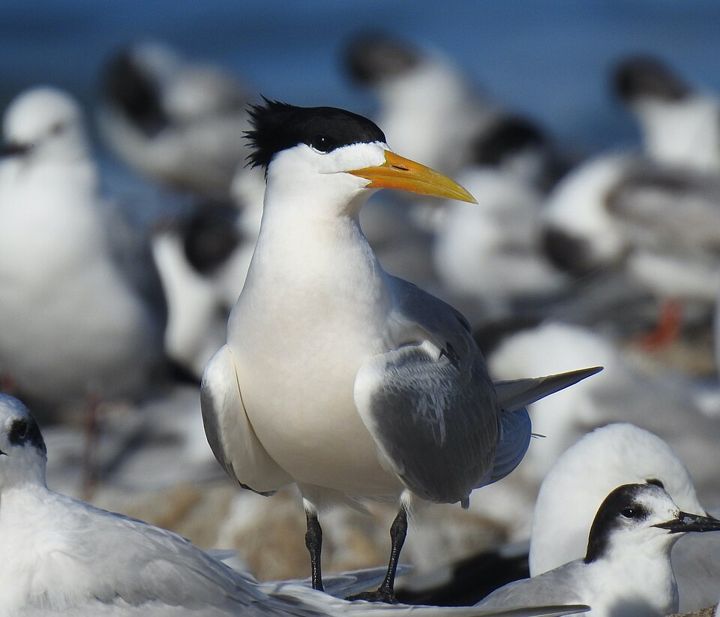
A large tern, 46–49 cm long with a 125–130 cm wingspan. A long yellow bill of 5.4–6.5 cm, black legs and a glossy black crest, shaggy at the rear like uncombed hair. In breeding plumage a white forehead, dusky-grey back and inner wings and white underparts. In winter the upperparts wear paler, the crown turns white and only a peppered black crest and mask remain at the rear. Juveniles have the winter head pattern and upperparts patterned grey, brown and white.
Habitat
Tropical and subtropical coasts and islands, nesting in dense colonies on beaches, rocky islets and coral cays; plunge-dives for fish close inshore, follows fishing boats and perches on pilings and buoys.
Distribution
From South Africa around the Indian Ocean to the central Pacific and Australia, north to the far south of Japan; breeding colonies on the south-east China coast and in Taiwan (Matsu, Keelung, Yilan), and seen all year on Singapore's coasts and anchorages, often with other terns on buoys.
Season and behaviour
All year in Singapore; breeds April to September on the south-east China coast; mainly summer in southern Japan. Disperses widely after nesting. The critically endangered Chinese crested tern has been found nesting within the Matsu colonies.
Photography tips
These are the FilmAnalysis editors' notes, not content from the sources.
The shaggy black crest and yellow bill are the field mark and the point of the picture, best as a side-lit portrait. Birds on buoys and pilings can be approached slowly from a boat or breakwater. Plunge-dives need 1/3200 s; with fishing boats, use a slightly wider lens to keep the setting.
Field ethics: keep a distance at which the bird does not change its behaviour; never approach or publish nest sites; no baiting, playback or flash; never clear vegetation around a nest; follow reserve rules and stay on paths.
Photographic styles
Documentary of harbours and sea; one yellow accent.
Similar species
Lesser crested tern (slightly smaller, orange bill, scarce on the south China coast); Chinese crested tern (yellow bill with a black tip, critically endangered, nests among this species); sandwich tern (black bill with yellow tip, Europe and West Asia).
Related badge
The album badge "a gull" unlocks when the vision model explicitly names a a gull in your photo and you rate the analysis. The badge stops at "a gull": it does not tell species apart, and this page existing unlocks nothing.
The illustration is original FilmAnalysis artwork. The photograph is from Wikimedia Commons; its licence and author are under it.