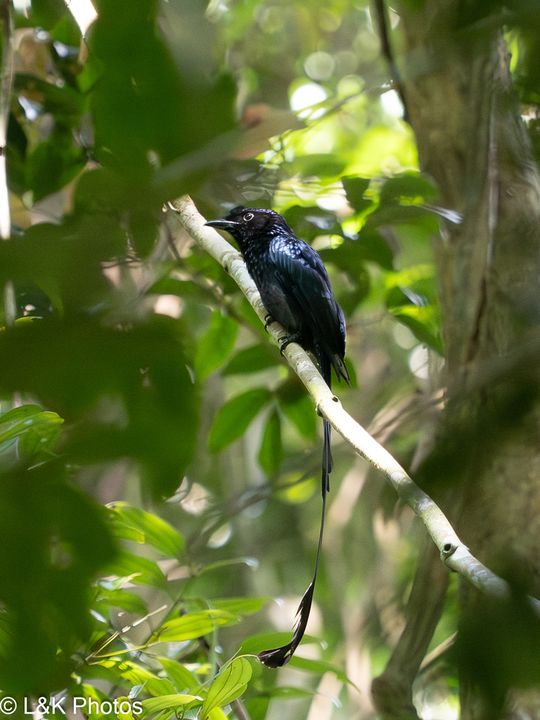
Photo: lallen, via iNaturalist, public domain / CC0. Unmodified apart from resizing.
Region
Singapore and tropical Asia
Habitat
forest
Colour
black, blue
Size
medium (20 to 50 cm)
Identification
Glossy black all over; in most of Asia the largest drongo. A crest of curled feathers rises from above the bill along the crown, longer or shorter by subspecies. Its mark is the pair of elongated outer tail feathers, bare-shafted with twisted webs only at the tips: in flight it looks like a black bird chased by two large bees.
Habitat
Forest, often perched in the open on high, bare branches.
Distribution
Foothills below 1,200 m from the western to the eastern Himalayas, the hills of peninsular India and the Western Ghats, and through mainland and island Southeast Asia east to Borneo and Java.
Season and behaviour
Eats mainly insects, also fruit and nectar from flowering trees, and is active at dusk. Its calls are extremely varied, including accurate imitations of other birds and their alarm calls; it joins mixed foraging flocks and sometimes steals insects that other birds catch or flush. It mobs larger birds when nesting.
Photography tips
These are the FilmAnalysis editors' notes, not content from the sources.
Follow the loud, varied calls. It likes high bare perches, often against the sky: add +1 to +2 EV or the black plumage turns to mush. For a full portrait leave room below so both rackets fit; side light brings out the blue sheen. Never use playback.
Field ethics: keep a distance at which the bird does not change its behaviour; never approach or publish nest sites; no baiting, playback or flash; never clear vegetation around a nest; follow reserve rules and stay on paths.
Photographic styles
Minimal frames against the sky; compositions built on the long tail lines.
Similar species
Lesser racket-tailed drongo (flat rackets, hardly any crest).
Related badge
None yet. No validated photo recognition exists for this species, so no badge is tied to it: a name in the encyclopedia is not evidence in a photograph.
The illustration is original FilmAnalysis artwork. The photograph is from iNaturalist; its licence and author are under it.
Why it is listed: this bird is named in the YouTube video description (波遊足跡 EP1) (the description text, not the subtitles). The video only shows that it was mentioned; names follow the IOC World Bird List 15.2 and the facts follow the sources below.