Japan and temperate East Asia, Singapore and tropical Asia
Habitat
rivers and wetlands
Colour
brown, white, green
Size
small (under about 20 cm)
IUCN status
Least Concern
IOC breeding range
PAL (subarctic to temperate zone taiga wetlands of Palearctic: Scandinavia (except far n) s to Germany, e to e Sakha Republic (ne Siberia), s through n, e Kazakhstan and Kyrgyzstan, w, nw Xinjiang (nw China), n Mongolia and Inner Mongolia (ne China))
IOC non-breeding range
sw PAL, AF, OR : temperate to tropical inland and coastal wetlands of Palearctic: s British Isles to Canary Is. (Macaronesia, w of n Africa), Africa (except far s), Middle East, s, se Asia to Malay Pen., e China, n, w Philippines, Taiwan, Korean Pen. and e, s Japan
Identification
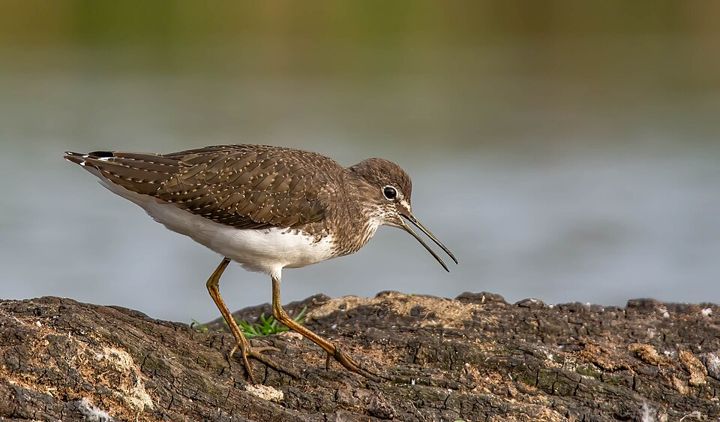
A rather plump small wader. Dark greenish-brown back and wings spotted with fine white dots (most in breeding adults, fewer in winter and in juveniles), greyish head and breast, otherwise white below; legs and short bill both dark green. In flight the wings are dark above and below against a brilliant white rump, with a three-note whistle. Unlike most waders it nests in trees in the old nests of other birds.
Habitat
Breeds in marshy taiga woodland from the subarctic to the temperate zone; on passage and in winter prefers small sheltered fresh water, such as ditches, paddies, pond edges, streams and settling ponds, rarely open beaches.
Distribution
Breeds across subarctic Europe and east through Siberia; winters in southern Europe, tropical Africa, the Indian subcontinent and South-East Asia. Found across northern and southern China, common in winter in eastern China and Japan; scarce in Singapore.
Season and behaviour
In eastern China and Japan from September to April, usually alone. Flushed, it springs up with a clear tluee-wee-wee, flies high and zigzagging, then drops back to the water's edge.
Photography tips
These are the FilmAnalysis editors' notes, not content from the sources.
It is wary and usually sees you first, so wait by paddy ditches from a car or hide. The take-off, white rump against dark wings, is the picture: preset 1/2000 s. The white spots on the back show only close up in front light.
Field ethics: keep a distance at which the bird does not change its behaviour; never approach or publish nest sites; no baiting, playback or flash; never clear vegetation around a nest; follow reserve rules and stay on paths.
Photographic styles
Plain documentary of ditches and paddies; black-and-white flight.
Similar species
Wood sandpiper (longer yellowish legs, pale underwing, coarser back spots); common sandpiper (white hook, tail-bobbing, low flight over water); the American solitary sandpiper is near-identical but lacks the white rump.
Related badge
None yet. No validated photo recognition exists for this species, so no badge is tied to it: a name in the encyclopedia is not evidence in a photograph.
The illustration is original FilmAnalysis artwork. The photograph is from Wikimedia Commons; its licence and author are under it.