Japan and temperate East Asia, Singapore and tropical Asia
Habitat
forest
Colour
grey, brown, black
Size
medium (20 to 50 cm)
IUCN status
Least Concern
IOC breeding range
OR (Himalayas to e, se Asia)
IOC non-breeding range
Indian subcontinent, se Asia s to Greater Sundas
Identification
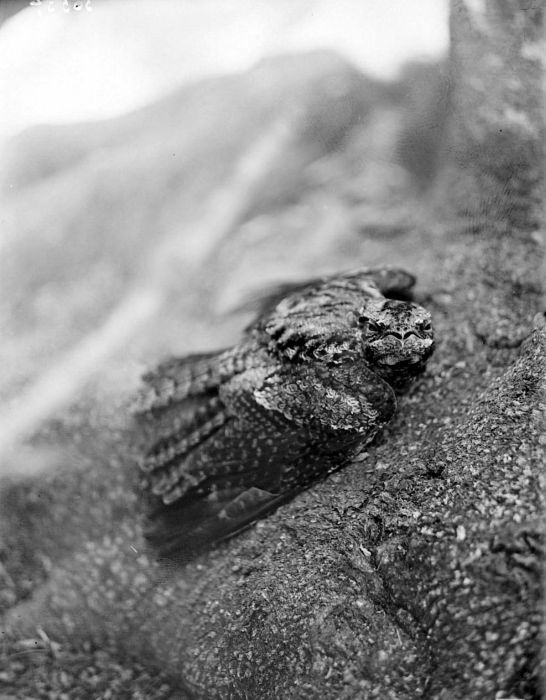
A medium-sized nightjar with a large head and eye, long tail, weak bill and short legs. The whole plumage is a fine vermiculation of grey-white and dark brown, with a prominent black central stripe on the crown, black scapulars with buff spots and round buff spots on the wing-covert tips. By day it lies lengthwise along a branch like a piece of bark; males have white patches in the wings and tail that show in flight.
Habitat
Forest edge, open woodland, clearings and mixed forest in hills and mountains; hawks insects after dusk and rests by day on a horizontal branch or on the ground, with migrants stopping in Japanese city parks.
Distribution
Breeds from south-eastern Russia through China, Korea and Japan to northern Indochina and west along the Himalayas; mostly migratory, wintering in Indochina south to Java, resident in the warm south. Recorded on passage in Singapore every year. Sometimes treated as a subspecies of the South Asian jungle nightjar.
Season and behaviour
In eastern China and Japan from April to October; passage in Singapore in October–November and March–April. On summer nights it gives a fast, continuous kyo-kyo-kyo; the Japanese nightjar's call appears in Kenji Miyazawa's children's story.
Photography tips
These are the FilmAnalysis editors' notes, not content from the sources.
By day it does not move: find it by the glint of the eye and the extra length on a branch, then photograph from a distance with a long lens, never flushing it and never with flash. Side light reveals the vermiculation and the black crown stripe; soft overcast suits its low-contrast plumage. Dusk flight is nearly impossible, so do not force it.
Field ethics: keep a distance at which the bird does not change its behaviour; never approach or publish nest sites; no baiting, playback or flash; never clear vegetation around a nest; follow reserve rules and stay on paths.
Photographic styles
Close-ups of camouflage and bark texture; low-contrast grey-brown.
Similar species
Jungle nightjar (South Asia, often treated as the same species); large-tailed nightjar (South-East Asia, longer tail, knocking call); European nightjar (Xinjiang, warmer tones).
Related badge
None yet. No validated photo recognition exists for this species, so no badge is tied to it: a name in the encyclopedia is not evidence in a photograph.
The illustration is original FilmAnalysis artwork. The photograph is from Wikimedia Commons; its licence and author are under it.