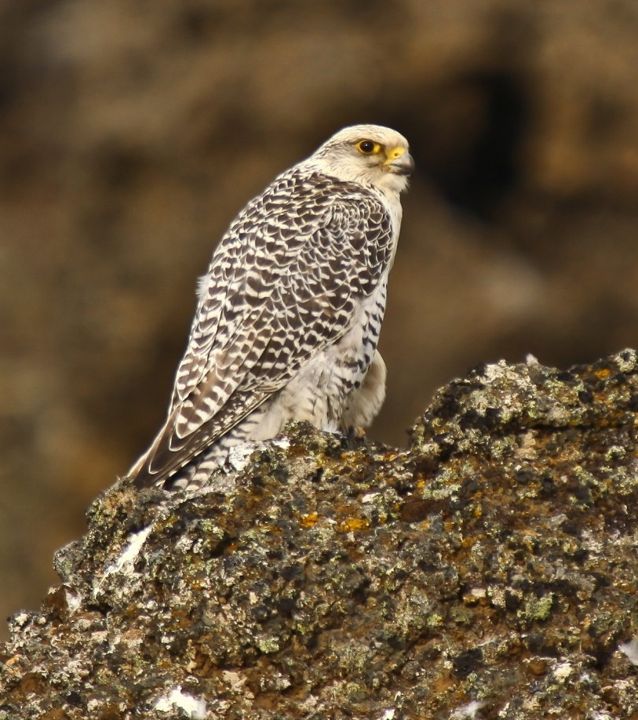
Photo: Ólafur Larsen (derivative work: Bogbumper), via Wikimedia Commons, licensed CC BY-SA 2.0. Unmodified apart from resizing.
Region
Japan and temperate East Asia
Habitat
coast and mangroves
Colour
white, grey, black
Size
large (over 50 cm)
IUCN status
Least Concern
IOC breeding range
NA, PAL (Arctic Europe, Asia and North America)
Identification
The largest falcon in the world, about the size of the largest buteos but a little heavier. Males 48–61 cm long, wingspan 110–130 cm, 805–1,350 g; females bulkier, 51–65 cm, wingspan 124–134 cm, 1,180–2,100 g. Plumage varies by region from all white to dark grey-brown, the white form the most prized; broad blunt wings and a long tail. In old China the haidongqing, the most treasured hunting falcon of the Liao and Jin.
Habitat
Arctic coasts and tundra and northern islands, nesting on cliffs; in winter it disperses to coasts, estuaries and open country, hunting ptarmigan, seabirds and ducks.
Distribution
Breeds on the Arctic coasts and tundra of Europe, Asia and North America, mainly resident, some dispersing widely after breeding and in winter. Scattered winter records in Heilongjiang and Jilin, historically the hunting falcon of the north-east; occasional in Hokkaido in winter; absent from Singapore.
Season and behaviour
Very few wintering birds in north-east China and Hokkaido from December to February, mostly on coasts, estuaries and open farmland; news of one is chased by birders from far away.
Photography tips
These are the FilmAnalysis editors' notes, not content from the sources.
It sits for long spells on a cliff top, pylon or the ground: a car and 600 mm from far off, and never close enough to move it, since one flight takes it kilometres. The white form on snow needs a stop more; on grey birds meter on the breast markings. In pursuit it is extremely fast, and only 1/3200 s gives a chance.
Field ethics: keep a distance at which the bird does not change its behaviour; never approach or publish nest sites; no baiting, playback or flash; never clear vegetation around a nest; follow reserve rules and stay on paths.
Photographic styles
A great raptor of northern coasts; white and grey snow tones.
Similar species
Saker (slightly smaller, thin moustache, mainly brown, steppe); peregrine (smaller, broad moustache, black head); snowy owl (white but an owl, with a round disc).
Related badge
None yet. No validated photo recognition exists for this species, so no badge is tied to it: a name in the encyclopedia is not evidence in a photograph.
The illustration is original FilmAnalysis artwork. The photograph is from Wikimedia Commons; its licence and author are under it.