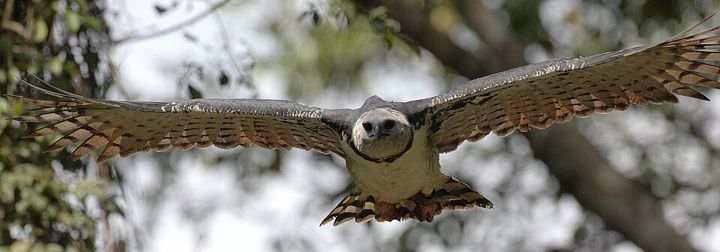
Elsewhere (in East Asia only in bird parks or botanic gardens)
Habitat
forest
Colour
grey, white, black
Size
large (over 50 cm)
IUCN status
Vulnerable
IOC breeding range
MA, SA (s Mexico to ne Argentina)
Identification
The largest and most powerful raptor of the Neotropics and among the largest eagles in the world, approached in size only by the Philippine and Steller's sea eagles. Grey head with a divided dark grey crest raised in alarm or excitement; slate-black upperparts, white underparts with a broad black breast band; massive legs and feet with talons comparable to a grizzly bear's claws. Lives in the upper canopy of tropical lowland forest. Named after the harpies of Greek myth.
Habitat
The emergent layer of tropical lowland rainforest, nesting and hunting in the tallest trees, feeding chiefly on sloths, monkeys and other arboreal mammals; rare and elusive throughout its range.
Distribution
From southern Mexico through Central America into South America as far as north-eastern Argentina, most common in Brazil; nearly extinct in Central America except parts of Panama and Costa Rica because of logging. Absent from East Asia, kept in a few zoos; Birdwatching Notebook lists it as an exotic. Vulnerable.
Season and behaviour
Resident, seen all year within its range; a nesting cycle lasts more than two years and a pair raises one chick.
Photography tips
These are the FilmAnalysis editors' notes, not content from the sources.
In the wild it is photographed almost only near a known nest tree with a guide at long range, 600 mm upwards, and never under the nest tree. Against canopy backlight the white belly clips, so take a stop off; the raised crest is the head portrait. Label zoo birds as captive.
Field ethics: keep a distance at which the bird does not change its behaviour; never approach or publish nest sites; no baiting, playback or flash; never clear vegetation around a nest; follow reserve rules and stay on paths.
Photographic styles
A giant eagle in the canopy; a solemn portrait in black, white and grey.
Similar species
Crested eagle (Central and South America, smaller, single crest); Philippine eagle (longer shaggier crest).
Related badge
None yet. No validated photo recognition exists for this species, so no badge is tied to it: a name in the encyclopedia is not evidence in a photograph.
The illustration is original FilmAnalysis artwork. The photograph is from Wikimedia Commons; its licence and author are under it.