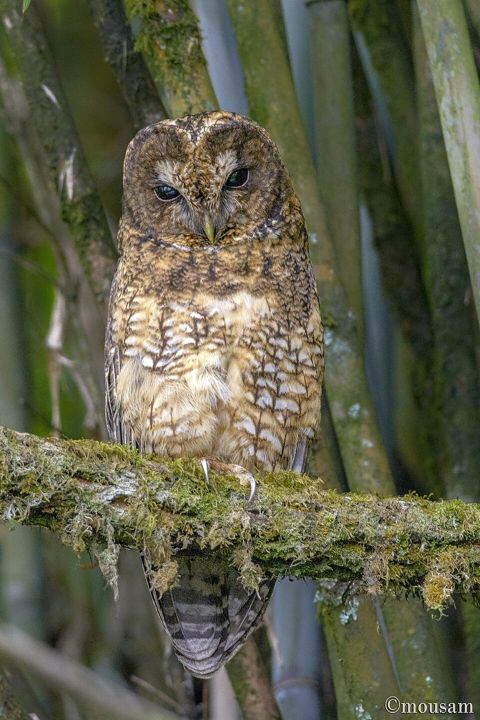
A medium-sized owl, 35–40 cm long. Round head without ear tufts, dark brown with pale speckling; warm tawny plumage marked light brown, dark brown and white; the breast light brown and white with dark brown vertical streaks, wings and tail darker with white bars. A paler facial disc, a small hooked yellow bill and dark eyes. Sexes alike. Nocturnal and rarely seen over most of its range, with few studies.
Habitat
Mountain conifer, broadleaf and mixed forest, nesting in tree holes and rock crevices; hunts small mammals and birds in the forest at night and roosts by day against a trunk.
Distribution
The Himalayas to East Asia: from Nepal and Bhutan through south-west, central, eastern and northern China's hills to Taiwan and Korea. Formerly a subspecies of the tawny owl. Absent from Japan and Singapore. Declining but widespread; least concern.
Season and behaviour
Resident, seen all year; its hooting on February to April nights is the main clue; occasionally found by day in big trees in parks and temple grounds.
Photography tips
These are the FilmAnalysis editors' notes, not content from the sources.
When you find it roosting against a big trunk by day, use a long lens from a distance at about 1/250 s with stabilisation; the dark eyes read only in soft light. Never use flash or playback and never crowd it; once it opens its eyes wide at you, step back.
Field ethics: keep a distance at which the bird does not change its behaviour; never approach or publish nest sites; no baiting, playback or flash; never clear vegetation around a nest; follow reserve rules and stay on paths.
Photographic styles
Round-headed silhouettes beside a trunk; quiet warm brown.
Similar species
Tawny owl (the European and West Asian relative, once lumped); Ural owl (larger, longer tail, grey disc, north-east); brown wood owl (larger, dark-rimmed disc, southern China).
Related badge
The album badge "an owl" unlocks when the vision model explicitly names a an owl in your photo and you rate the analysis. The badge stops at "an owl": it does not tell species apart, and this page existing unlocks nothing.
The illustration is original FilmAnalysis artwork. The photograph is from Wikimedia Commons; its licence and author are under it.