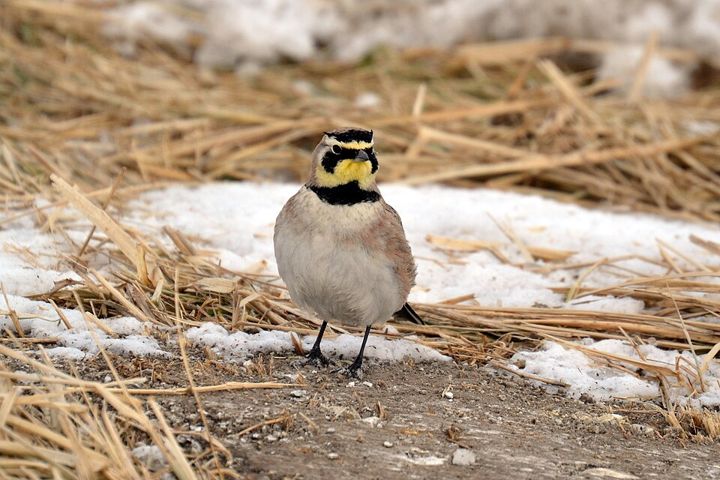
Unlike most larks, distinctive on the ground: brown-grey above and pale below with a striking black-and-yellow face pattern (black mask and breast band, yellow face and throat). The tail is mostly black apart from the central feathers, contrasting with the paler body, especially in flight. The summer male has two black horns of feathers on the head. 16–20 cm long, 28–48 g. The song is high, thin and tinkling, given in flight.
Habitat
Open bare country: alpine meadows, gobi, saline flats, farmland, dunes, beaches and tundra, running on the ground for seeds and insects and flocking in winter.
Distribution
Across the northern hemisphere; in China in Xinjiang, on the Tibetan plateau, in Inner Mongolia and the north, some moving to the North China Plain in winter; a rare winter visitor to Japan (occasionally Hokkaido); absent from Singapore. In Europe it winters on shorelines, hence its other name, shore lark.
Season and behaviour
Breeds in northern China and on the plateau from April to August, the male singing in flight; winter flocks on northern fields and river beds. Present all year on the Tibetan plateau, often on roadside meadows.
Photography tips
These are the FilmAnalysis editors' notes, not content from the sources.
It runs along the ground: lie down with a long lens and wait for it to stop and raise its head, with the black-and-yellow face in front light; the horns show only in side light. Plateau birds are tame and can be approached slowly by car. In winter the small brown bird is clean against snow; add a stop for the snow when metering.
Field ethics: keep a distance at which the bird does not change its behaviour; never approach or publish nest sites; no baiting, playback or flash; never clear vegetation around a nest; follow reserve rules and stay on paths.
Photographic styles
A small bird on bare plateau ground; the yellow-and-black face pattern.
Similar species
Eurasian skylark (no black-and-yellow face, short crest); oriental skylark (smaller, no black on the face); snow bunting (winter, large white wing patches).
Related badge
None yet. No validated photo recognition exists for this species, so no badge is tied to it: a name in the encyclopedia is not evidence in a photograph.
The illustration is original FilmAnalysis artwork. The photograph is from Wikimedia Commons; its licence and author are under it.