Elsewhere (in East Asia only in bird parks or botanic gardens)
Habitat
towns and gardens
Colour
blue, yellow
Size
large (over 50 cm)
IUCN status
Vulnerable
IOC breeding range
SA (c Brazil to se Bolivia and ne Paraguay)
Identification
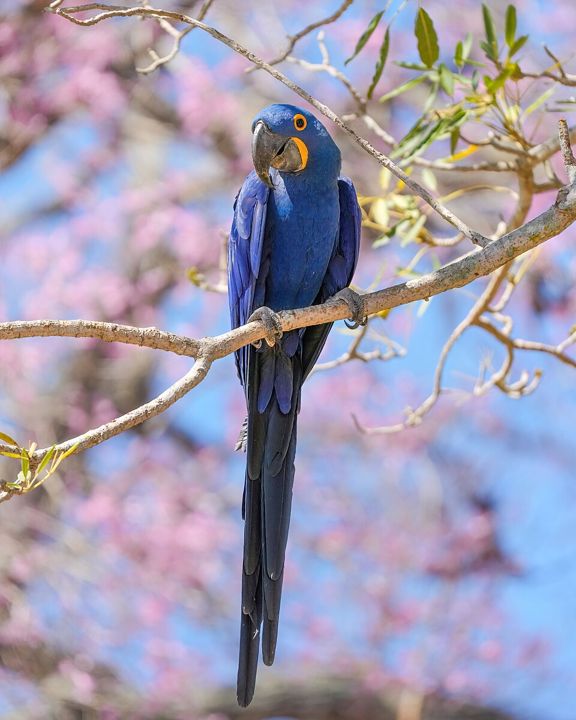
The longest parrot in the world: about 1 m from the top of the head to the tip of the long pointed tail, 1.2–1.7 kg, each wing 38.8–42.5 cm. Feathers almost entirely blue, lighter above, the neck sometimes slightly grey, large parts of the underwing and undertail black; the bare skin round the eye and under the bill is a strong vibrant yellow, the identifying mark. The black bill is the largest of any living parrot.
Habitat
Semi-open savanna and palm groves (the Pantanal and Cerrado), feeding mainly on the nuts of a few palms and nesting in holes in manduvi trees, which depend on the toco toucan for 83% of their seed dispersal while the toucan eats 53% of the macaw's eggs.
Distribution
Central and eastern Brazil, south-eastern Bolivia and north-eastern Paraguay. Habitat loss and trapping for the pet trade have cut its numbers; vulnerable. In East Asia seen only in zoos and bird parks, including Singapore's; Birdwatching Notebook lists it as an exotic.
Season and behaviour
Seen all year in bird parks; resident in the wild, breeding from July to December.
Photography tips
These are the FilmAnalysis editors' notes, not content from the sources.
The blue is truest in soft diffuse light; direct sun turns it purple and bleaches the yellow, so meter on the yellow face skin. In parks pairs sit together preening, a two-bird composition for a medium lens. A metre of bird wants a portrait frame. Label it captive.
Field ethics: keep a distance at which the bird does not change its behaviour; never approach or publish nest sites; no baiting, playback or flash; never clear vegetation around a nest; follow reserve rules and stay on paths.
Photographic styles
A whole field of cobalt with one point of yellow; great parrots in pairs.
None yet. No validated photo recognition exists for this species, so no badge is tied to it: a name in the encyclopedia is not evidence in a photograph.
The illustration is original FilmAnalysis artwork. The photograph is from Wikimedia Commons; its licence and author are under it.