PAL (Ukraine to Mongolia and n China and s to Israel, Iran and Pakistan)
IOC non-breeding range
n AF, s Asia
Identification
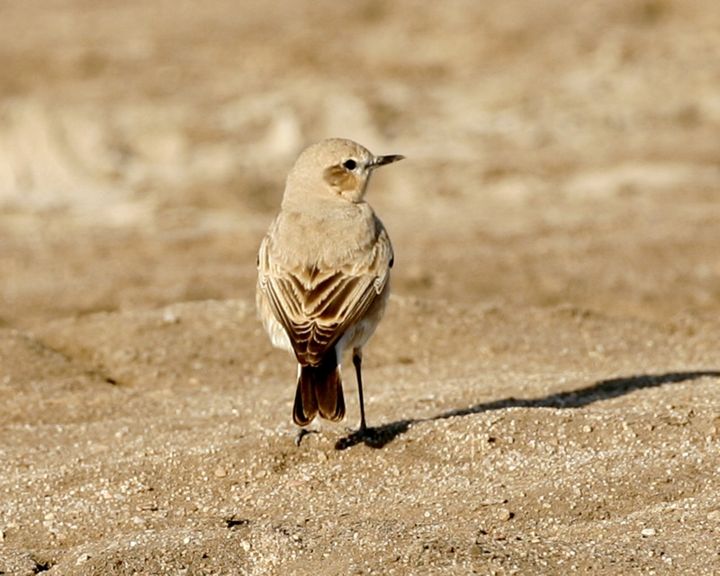
A small passerine with the sexes alike. Pale sandy brown above with an isabelline tinge (a pale grey-yellow parchment colour), white rump and uppertail coverts; brownish-black tail feathers with a large white base, more than half the length on the outer feathers; a creamy-white brow, pale brown ear coverts; cream chin, pale buff throat, sandy breast, creamy belly, brownish-black wing feathers edged creamy buff. An upright stance on long legs.
Habitat
Arid desert and steppe: gravel gobi, scrub desert, fixed dunes, dry-zone farmland and grassland up to about 3,500 m, running on the ground after insects and standing on mounds and stones.
Distribution
Breeds from Ukraine to Mongolia and northern China and south to Israel, Iran and Pakistan; winters in Africa and north-west India. Common from April to September on the desert steppes of Inner Mongolia, Gansu, Qinghai, Xinjiang and Shaanxi; a vagrant to Japan, absent from Singapore and very rare in western Europe.
Season and behaviour
In north-west China and Inner Mongolia from April to September, the male making short song flights; departs south after September. Longest on a mound top in the early morning.
Photography tips
These are the FilmAnalysis editors' notes, not content from the sources.
A sand-coloured bird on sand-coloured ground is outlined only when it stands on top of a mound: a long lens from low down puts it against sky or distant hills. The white rump and tail base appear in the instant of take-off, at 1/2000 s. Desert sun is harsh, so shoot early and late.
Field ethics: keep a distance at which the bird does not change its behaviour; never approach or publish nest sites; no baiting, playback or flash; never clear vegetation around a nest; follow reserve rules and stay on paths.
Photographic styles
Sand-coloured desert minimalism; upright silhouettes on a mound.
Similar species
Female northern wheatear (slightly smaller, darker wings, broader black T on the tail); isabelline, northern and desert wheatear females are very alike and told by the upright stance and the extent of black on the tail.
Related badge
None yet. No validated photo recognition exists for this species, so no badge is tied to it: a name in the encyclopedia is not evidence in a photograph.
The illustration is original FilmAnalysis artwork. The photograph is from Wikimedia Commons; its licence and author are under it.