PAL, NA (high Arctic is. from Greenland, Svalbard (n of Norway), Franz Josef Land to Herald I. (e of Wrangel I., n of Chukotka Pen.; n Russia) and n Canada)
IOC non-breeding range
Arctic Ocean pack-ice edge to se Greenland, Labrador and Bering seas
Identification
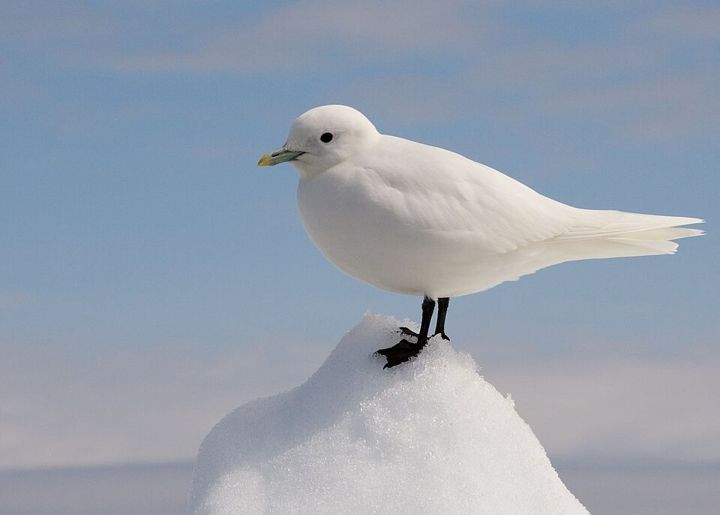
A small gull, 40–43 cm long with a wingspan of 108–120 cm; males 500–687 g, females 448–583 g. Easy to identify: the adult is pure white all over, without the grey back of other gulls; pigeon-like in shape, with short black legs; the thick bill blue-grey with a yellow tip, the eye dark with a narrow dark red orbital ring. Juveniles have a dusky face and variable black flecking on wings and tail and take two years to turn fully white.
Habitat
The edge of the high-Arctic pack ice, often following polar bears to scavenge their kills, also taking fish and invertebrates; breeds on cliffs and scree on Arctic islands.
Distribution
Circumpolar breeder from Greenland, Svalbard and Franz Josef Land to Herald Island east of Wrangel and northern Canada; winters at the pack-ice edge to south-east Greenland, Labrador and the Bering Sea. In East Asia only a very few records from northern Japan; absent from China and Singapore. Near threatened.
Season and behaviour
Extremely rare in Hokkaido in winter, usually a lone bird in a fishing port or on sea ice. Arctic cruise ships see it regularly around Svalbard in July and August.
Photography tips
These are the FilmAnalysis editors' notes, not content from the sources.
An all-white bird on snow and ice needs one to one and a half stops more so that the bill and dark eye keep their contrast. It follows polar bears over the floes, so use a long lens from the ship; it is curious and sometimes comes to the boat itself. Grey sea and white gull make a low-saturation picture that suits empty space.
Field ethics: keep a distance at which the bird does not change its behaviour; never approach or publish nest sites; no baiting, playback or flash; never clear vegetation around a nest; follow reserve rules and stay on paths.
Photographic styles
Ice and white gull minimalism; one yellow bill tip.
Similar species
Iceland and glaucous gulls (larger, pale grey back); leucistic gulls of other species (different shape and bill colour).
Related badge
The album badge "a gull" unlocks when the vision model explicitly names a a gull in your photo and you rate the analysis. The badge stops at "a gull": it does not tell species apart, and this page existing unlocks nothing.
The illustration is original FilmAnalysis artwork. The photograph is from Wikimedia Commons; its licence and author are under it.