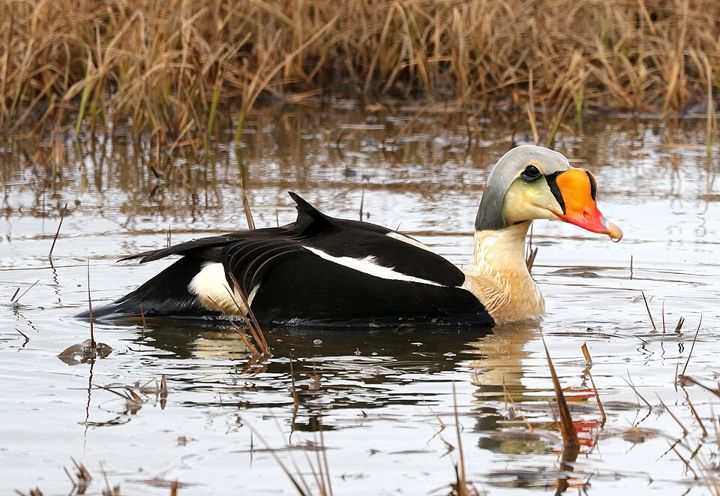
Photo: ALAN SCHMIERER, via Wikimedia Commons, public domain / CC0. Unmodified apart from resizing.
Region
Elsewhere (in East Asia only in bird parks or botanic gardens)
Habitat
coast and mangroves
Colour
black, white, orange
Size
large (over 50 cm)
IUCN status
Least Concern
IOC breeding range
NA, PAL (coastal n, c Greenland, Svalbard (n of Norway), Russia from e of the White Sea to Chukotka (ne Russia); Arctic Coastal Plain of Alaska, n slope of Canada and associated Arctic is.)
IOC non-breeding range
to Kamchatka (se Russia) and Aleutian Is.; Newfoundland (se Canada), s Greenland, Iceland, and n Norway
Identification
A large sea duck, 50–70 cm long with a wingspan of 86–102 cm, males averaging 1.67 kg. The male is unmistakable: mostly black body, buff-tinged white breast, pale bluish-grey head, nape and neck, pale green cheek, a red bill separated from the face by a thin black line and topped by a large distinctive yellow knob; some tertials curve up into sails along the back. The female is warm brown with dense crescent-shaped dark markings.
Habitat
Most of the year in high-latitude coastal seas diving for shellfish, migrating in June and July to Arctic tundra to breed beside fresh water, laying four to seven eggs in a ground scrape lined with grass and down.
Distribution
Breeds on Arctic coasts of north-eastern Europe, North America and Asia, from Greenland, Svalbard and Russia east of the White Sea to Chukotka, Alaska's North Slope and Canada; winters off Kamchatka, the Aleutians, Newfoundland, southern Greenland, Iceland and northern Norway. In East Asia only a very few records from Hokkaido; absent from China and Singapore.
Season and behaviour
Extremely rare in Hokkaido in winter; Norway's Varangerfjord holds flocks of over ten thousand from January to March and is the place to watch.
Photography tips
These are the FilmAnalysis editors' notes, not content from the sources.
The male's many-coloured head needs soft front light, since strong sun bleaches the pale blue-grey; focus on the yellow knob. Flocks at sea are shot from a quay or boat with a long lens, low over the water; black-and-white wings on take-off at 1/2000 s. Mind the gear in extreme cold.
Field ethics: keep a distance at which the bird does not change its behaviour; never approach or publish nest sites; no baiting, playback or flash; never clear vegetation around a nest; follow reserve rules and stay on paths.
Photographic styles
Many-coloured heads on Arctic water; small accents on a black-and-white body.
Similar species
Common eider (male with white back and black crown, no knob); Steller's eider (much smaller).
Related badge
The album badge "a duck" unlocks when the vision model explicitly names a a duck in your photo and you rate the analysis. The badge stops at "a duck": it does not tell species apart, and this page existing unlocks nothing.
The illustration is original FilmAnalysis artwork. The photograph is from Wikimedia Commons; its licence and author are under it.