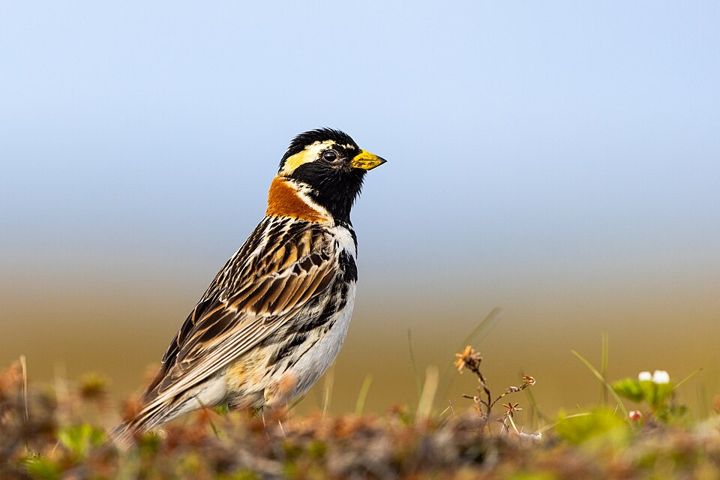
Photo: Alaska Region U.S. Fish & Wildlife Service from Anchorage, United States, via Wikimedia Commons, public domain / CC0. Unmodified apart from resizing.
Region
Japan and temperate East Asia
Habitat
towns and gardens
Colour
brown, black, white
Size
small (under about 20 cm)
IUCN status
Least Concern
IOC breeding range
NA, PAL (n)
IOC non-breeding range
c PAL, s USA
Identification
A robust bunting with a thick yellow seed-eater's bill. The summer male has a black head and throat, white eye-stripe, chestnut nape, white underparts and a heavily streaked black-grey back; other plumages have a plainer orange-brown head, browner back and chestnut nape and wing panels. 15–16 cm long, 22–33 g, wingspan 22–29 cm. The long hind claw gives the name longspur.
Habitat
Open country: Arctic tundra when breeding; in winter grassland, marsh, plain farmland and sparse hill woodland, running over the ground of stubble fields in flocks for seeds, mixed with larks and snow buntings.
Distribution
Circumpolar breeder across Arctic Europe, the Palearctic, Canada and the northernmost United States; winters on the Russian steppes, in the southern United States and elsewhere. In China in winter in the north-east, Inner Mongolia, Hebei, Jiangsu, Hubei, Sichuan and Gansu, common on North China Plain farmland; a scarce winter visitor to Japan; absent from Singapore.
Season and behaviour
In northern China from October to April in flocks on farmland, easiest on bare ground after snow; breeds in the Arctic from May to July.
Photography tips
These are the FilmAnalysis editors' notes, not content from the sources.
Winter plumage is plain, and the chestnut nape and wing panels are the clue: lie on a field bank with a long lens and let them walk up. Add a stop for snow. Before northward migration in March–April some males show the black face, the best chance of the year. Flocks rise and settle constantly, so 1/1600 s.
Field ethics: keep a distance at which the bird does not change its behaviour; never approach or publish nest sites; no baiting, playback or flash; never clear vegetation around a nest; follow reserve rules and stay on paths.
Photographic styles
Brown birds on snow-dusted fields; plain winter documentary.
Similar species
Snow bunting (large white wing areas); rustic, yellow-browed and other buntings (no chestnut nape or long hind claw); skylark (short crest, thin bill).
Related badge
None yet. No validated photo recognition exists for this species, so no badge is tied to it: a name in the encyclopedia is not evidence in a photograph.
The illustration is original FilmAnalysis artwork. The photograph is from Wikimedia Commons; its licence and author are under it.