to sw Europe, wc, ec Africa, nw India, and e North America
Identification
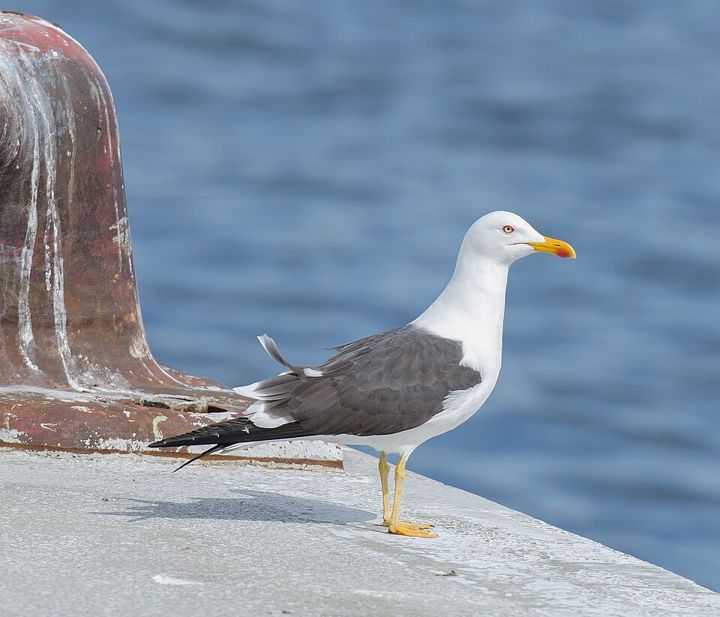
A large gull, smaller than the European herring gull, 51–64 cm long with a wingspan of 124–150 cm and weighing 452–1,100 g. Dark slate to near-black above depending on subspecies, white below, yellow legs, a yellow bill with a red spot. With the herring gull it forms a ring species round the Northern Hemisphere, the end members clearly distinct. Birds in East Asia are mostly the Central Asian heuglini, sometimes split as a species.
Habitat
Coasts, harbours, estuaries, fishing ports and refuse tips, also inland lakes and reservoirs; nests colonially on islands and rooftops.
Distribution
Breeds on the Atlantic and Arctic coasts from Greenland, Iceland and western Europe to north-central Siberia; winters in south-west Europe, Africa, north-west India and eastern North America, where it has increased greatly on the east coast in recent decades. Regular in winter in some numbers (heuglini type) on China's east coast and large inland waters, scarce in Japan; absent from Singapore.
Season and behaviour
In eastern China from November to March, in fishing ports and estuaries among Vega gulls; identified by the dark back and yellow legs.
Photography tips
These are the FilmAnalysis editors' notes, not content from the sources.
The dark grey back contrasts strongly with the white body: front light, eye level, 1/1000 s, with the yellow legs clear; frame it beside a herring gull to show the difference in back colour. Flocks following boats in fishing ports are the easiest, with a slightly wider lens for boats and ropes.
Field ethics: keep a distance at which the bird does not change its behaviour; never approach or publish nest sites; no baiting, playback or flash; never clear vegetation around a nest; follow reserve rules and stay on paths.
Photographic styles
Grey and yellow in a fishing port; gull-flock documentary.
The album badge "a gull" unlocks when the vision model explicitly names a a gull in your photo and you rate the analysis. The badge stops at "a gull": it does not tell species apart, and this page existing unlocks nothing.
The illustration is original FilmAnalysis artwork. The photograph is from Wikimedia Commons; its licence and author are under it.