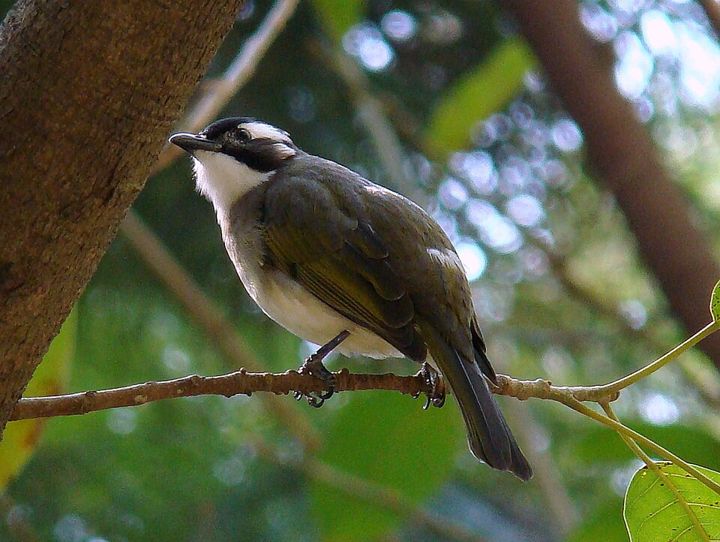
About 19 cm. Black crown and moustachial stripe with a large white patch on the nape and white from the eye to the back of the head, hence the Chinese name white-headed old man; greyish brown above with olive, wings and tail brown fringed bright olive; whitish below with a pale brown breast band. Males have a cleaner white nape and darker grey breast. Noisy, with a bright, variable cha-ko-lee song.
Habitat
Light woodland, scrub, farmland, towns, suburbs and city parks; lively and unafraid, eating insects, seeds and fruit. In Taiwan it dominates almost every lowland habitat.
Distribution
Central and southern China, northern Vietnam, Taiwan and the Ryukyu Islands; northern birds move south in winter. One of the commonest birds in cities south of the Yangtze, everywhere in the parks of Shanghai and Hangzhou; in Japan only on the Ryukyus, and absent from Singapore.
Season and behaviour
Resident, seen all year. Sings loudest on spring mornings from March to May from treetops and aerials; small flocks eat fruit in autumn and winter.
Photography tips
These are the FilmAnalysis editors' notes, not content from the sources.
It likes the highest twig or aerial for singing, so the sky makes a clean silhouette and the white nape lights up against the sun. In early spring it feeds on nectar in plum, cherry and magnolia blossom, the best background of all. A medium telephoto is enough; it is not shy.
Field ethics: keep a distance at which the bird does not change its behaviour; never approach or publish nest sites; no baiting, playback or flash; never clear vegetation around a nest; follow reserve rules and stay on paths.
Photographic styles
A city bird on a flowering branch; the pale colours of early spring.
Similar species
Red-whiskered bulbul (tall black crest, red cheek, southern China and Singapore); Styan's bulbul (much whiter head, eastern Taiwan); sooty-headed bulbul (all-black head, red vent).
Related badge
None yet. No validated photo recognition exists for this species, so no badge is tied to it: a name in the encyclopedia is not evidence in a photograph.
The illustration is original FilmAnalysis artwork. The photograph is from Wikimedia Commons; its licence and author are under it.