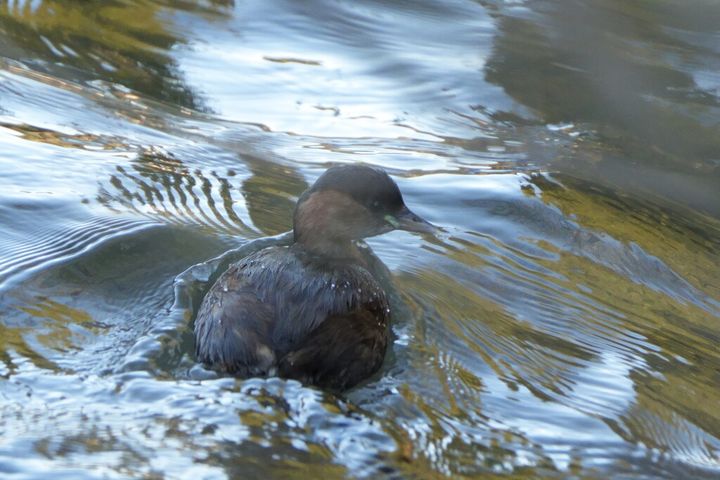
Photo: Andrew Cunnington, via iNaturalist, public domain / CC0. Unmodified apart from resizing.
Region
Japan and temperate East Asia, Singapore and tropical Asia
Habitat
rivers and wetlands
Colour
brown, red
Size
small (under about 20 cm)
IUCN status
Least Concern
IOC breeding range
PAL, AF, OR (Europe (except n) to c, s, e Asia, Philippines, New Guinea and Solomon Is.; Africa and Malagasy region)
Identification
23–29 cm long, the smallest grebe of Europe, Asia and Africa, with a short pointed bill. In summer dark above with rich rufous neck sides, cheeks and flanks and a bright yellow patch of bare skin at the gape; in winter and in juveniles the rufous turns dirty brownish grey. In winter the small round shape with a fluffy powder-puff rear is enough to identify it. Juveniles have black and white stripes on the cheeks and neck.
Habitat
Heavily vegetated freshwater lakes, ponds, reservoirs and slow rivers; some birds move to more open or coastal water in winter. It dives constantly for aquatic insects, tadpoles, small fish and crustaceans.
Distribution
Breeds in Europe except the far north, across Central, South and East Asia to the Philippines, New Guinea and the Solomon Islands, and in most of Africa and Madagascar. Resident on most waters in China and Japan, and found on Singapore's reservoirs and ponds.
Season and behaviour
Seen all year. The breeding call is a trilled weet-weet-weet like a horse whinnying; it migrates only where the water freezes. When alarmed it dives rather than flies.
Photography tips
These are the FilmAnalysis editors' notes, not content from the sources.
Alarmed, it dives and surfaces somewhere else half a minute later; do not chase it, sit on the bank and let it come to you. The rufous neck of summer saturates only in front light. The instant before a dive, and adults carrying chicks, are the pictures; a long lens from low down turns the water into a soft background.
Field ethics: keep a distance at which the bird does not change its behaviour; never approach or publish nest sites; no baiting, playback or flash; never clear vegetation around a nest; follow reserve rules and stay on paths.
Photographic styles
Empty water and reflections; quiet studies.
Similar species
Great crested grebe (much larger, white neck, crest); black-necked grebe (red eye, much whiter cheeks in winter).
Related badge
None yet. No validated photo recognition exists for this species, so no badge is tied to it: a name in the encyclopedia is not evidence in a photograph.
The illustration is original FilmAnalysis artwork. The photograph is from iNaturalist; its licence and author are under it.