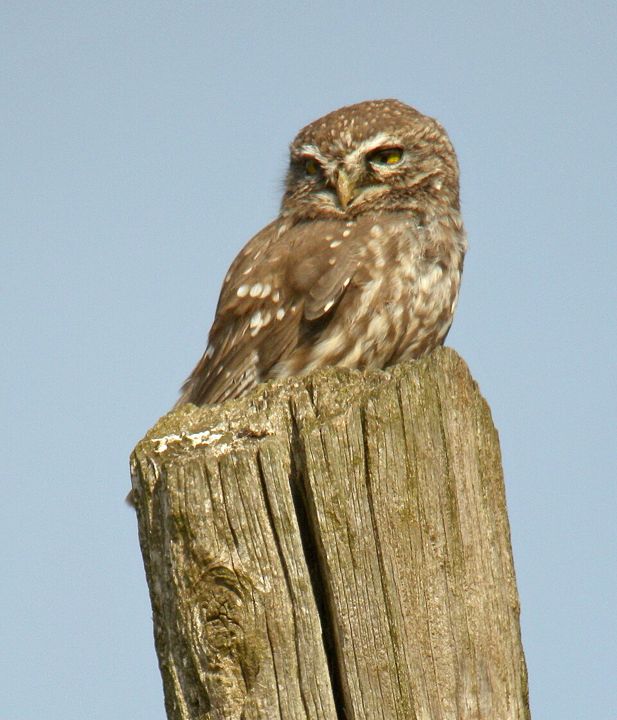
Photo: Frank Vassen from Brussels, Belgium, via Wikimedia Commons, licensed CC BY 2.0. Unmodified apart from resizing.
Region
Japan and temperate East Asia
Habitat
towns and gardens
Colour
brown, white, yellow
Size
small (under about 20 cm)
IUCN status
Least Concern
IOC breeding range
PAL, AF (widespread PAL and n, ne AF)
Identification
A small owl with a flat-topped head, a plump compact body and a short tail; about 22 cm long, wingspan 56 cm, about 180 g. The facial disc is flattened above the eyes, which with the white eyebrows gives a frowning, stern expression. Greyish-brown above spotted and streaked with white, pale below with dark streaks; a large head, long legs and yellow eyes. Juveniles are duller and lack the white crown spots. The flight is bounding like a woodpecker's.
Habitat
Open country, farmland, orchards, villages, derelict buildings and rocky ground, active by day as well, often standing on stone piles, earth walls and poles and bobbing when alarmed; nests in tree holes, wall cavities and rock crevices.
Distribution
The warmer parts of Europe, the Palearctic east to Korea, and North Africa; common in the countryside of northern and western China, breeding in loess cliffs and abandoned houses on the North China Plain; only a very few records from Japan; absent from Singapore. Introduced to Britain at the end of the nineteenth century.
Season and behaviour
Resident, seen all year; most active at dusk and dawn and often sunning at its hole by day. Breeds April to June and moults from July to November. The call is a rising kiew and repeated whistles.
Photography tips
These are the FilmAnalysis editors' notes, not content from the sources.
It suns itself at the hole or on an earth wall by day: approach slowly by car, and a medium telephoto is enough. The frown and yellow eyes want a head-on view; shoot bursts as it bobs. Earth walls and stone piles are a ready-made textured background. No flash, and never peer into the hole for chicks.
Field ethics: keep a distance at which the bird does not change its behaviour; never approach or publish nest sites; no baiting, playback or flash; never clear vegetation around a nest; follow reserve rules and stay on paths.
Photographic styles
A small owl on earth walls and stone piles; the loess-coloured countryside.
Similar species
Spotted owlet (barred rather than streaked below, Himalayas and southern China hills); boreal owl (larger disc, black around the eyes, northern conifers); collared owlet (smaller, false eyes on the nape).
Related badge
The album badge "an owl" unlocks when the vision model explicitly names a an owl in your photo and you rate the analysis. The badge stops at "an owl": it does not tell species apart, and this page existing unlocks nothing.
The illustration is original FilmAnalysis artwork. The photograph is from Wikimedia Commons; its licence and author are under it.