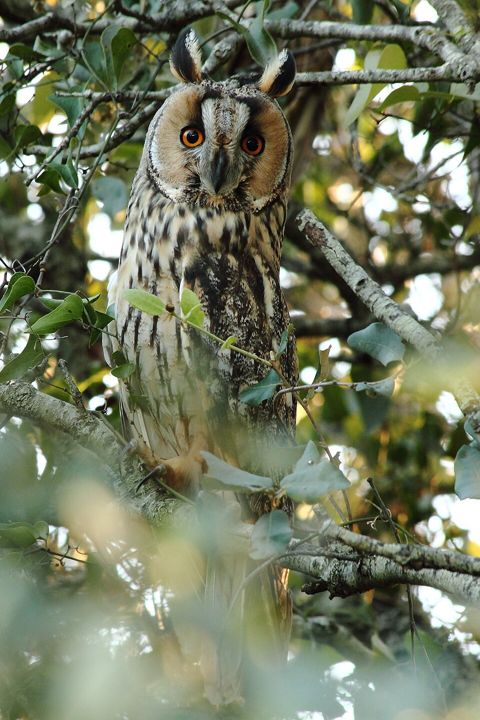
A medium-sized owl, slim and long-winged, with erectile ear tufts set closer to the centre of the head than in most owls. Ochraceous-tawny with a grey or brown wash, overlaid with dark vertical streaks most apparent on wings and back; the scapulars are marked whitish. Orange-buff facial disc, orange eyes. In flight the underwing shows dark carpal patches and buff to near-orange panels.
Habitat
Semi-open country, particularly woodland edge: roosts and nests in dense stands of trees and hunts rodents over open ground; in winter it roosts communally in evergreens in parks, cemeteries and shelterbelts, sometimes a dozen in one tree.
Distribution
Widespread in Europe, the Palearctic and North America. Breeds in northern China and winters from the north to the Yangtze basin, with regular winter roosts in the parks of Beijing and other northern cities; breeds in northern Japan and winters throughout; absent from Singapore.
Season and behaviour
Easiest to watch in eastern China and Japan from November to March, motionless by day in a cypress or pine; breeds from March to June in old nests of magpies and other birds.
Photography tips
These are the FilmAnalysis editors' notes, not content from the sources.
The winter roost is the best chance and the time for most restraint: never go close enough for them to open their eyes wide and raise their tufts, which is already alarm; use 600 mm from a distance for the half-closed sleeping look. A wide aperture softens the gaps in the foliage; never use flash, and do not linger or talk near a roost.
Field ethics: keep a distance at which the bird does not change its behaviour; never approach or publish nest sites; no baiting, playback or flash; never clear vegetation around a nest; follow reserve rules and stay on paths.
Photographic styles
Portraits among conifer branches; quiet brown and orange.
Similar species
Short-eared owl (very short tufts, yellow eyes, hunts open grassland by day); eagle owl (much larger); little owl (small, no tufts).
Related badge
The album badge "an owl" unlocks when the vision model explicitly names a an owl in your photo and you rate the analysis. The badge stops at "an owl": it does not tell species apart, and this page existing unlocks nothing.
The illustration is original FilmAnalysis artwork. The photograph is from Wikimedia Commons; its licence and author are under it.