NA, PAL (Holarctic high and low Arctic tundra, locally subarctic: nw, se Greenland, Arctic n Scandinavia to ne Siberia and Kamchatka (e Russia); Arctic and w, s Alaska through Arctic Canada to Ellesmere and Baffin is.)
IOC non-breeding range
highly pelagic and southerly: to offshore subantarctic and subtropical waters off w, sw, se Africa, s Madagascar, s Australia, Peru, Chile and ec Argentina
Identification
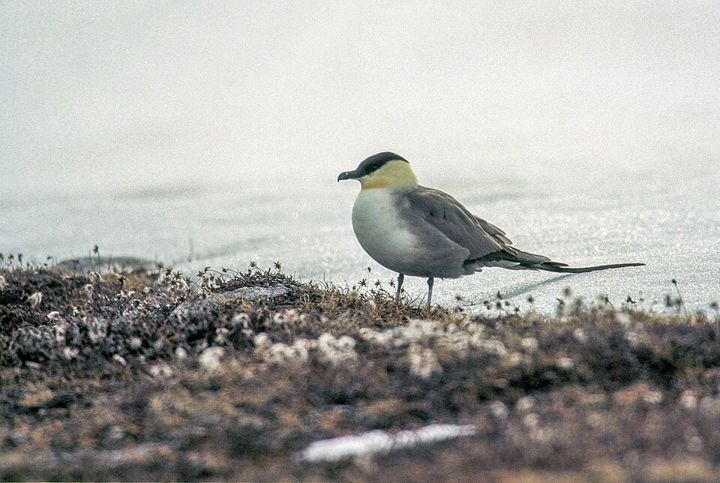
The smallest skua, 38–58 cm long of which the tail may be 29 cm, including the 15 cm streamers of the summer adult; wingspan 102–117 cm, 230–444 g. Adults have a grey back, dark primaries without a white flash, a black cap, white neck and underparts and the very long trailing tail. Juveniles are hard to separate from parasitic jaegers but are slimmer, longer-winged and more tern-like, with colder grey rather than brown tones.
Habitat
Breeds on Arctic tundra, feeding chiefly on lemmings, its numbers following the lemming cycle; outside the breeding season highly pelagic, wintering in subantarctic and subtropical offshore waters and rarely approaching the coast.
Distribution
Circumpolar breeder from Greenland and northern Scandinavia to north-east Siberia and Kamchatka and across Arctic Alaska and Canada; winters offshore from south-west Africa, southern Madagascar and southern Australia. Seen at sea off Japan's Pacific side on spring and autumn passage, with occasional records off eastern China and Singapore.
Season and behaviour
Off Japan in May and September–October, from whale-watching boats and ferries; scattered off eastern China in autumn. On the breeding grounds it often hovers over its territory.
Photography tips
These are the FilmAnalysis editors' notes, not content from the sources.
Almost only from a boat: 1/2500 s and continuous focus, the fast shutter countering the boat's movement. The adult's streamers are two ribbons against the light; side light gives the grey upperparts their depth. The grey-blue offshore sea is a clean background, so leave room for the trailing tail.
Field ethics: keep a distance at which the bird does not change its behaviour; never approach or publish nest sites; no baiting, playback or flash; never clear vegetation around a nest; follow reserve rules and stay on paths.
Photographic styles
Grey-blue offshore minimalism; the line of a long tail.
Similar species
Parasitic jaeger (slightly larger, short pointed streamers, white flash at the primary bases); pomarine jaeger (larger and heavier, twisted spoon-shaped streamers).
Related badge
None yet. No validated photo recognition exists for this species, so no badge is tied to it: a name in the encyclopedia is not evidence in a photograph.
The illustration is original FilmAnalysis artwork. The photograph is from Wikimedia Commons; its licence and author are under it.