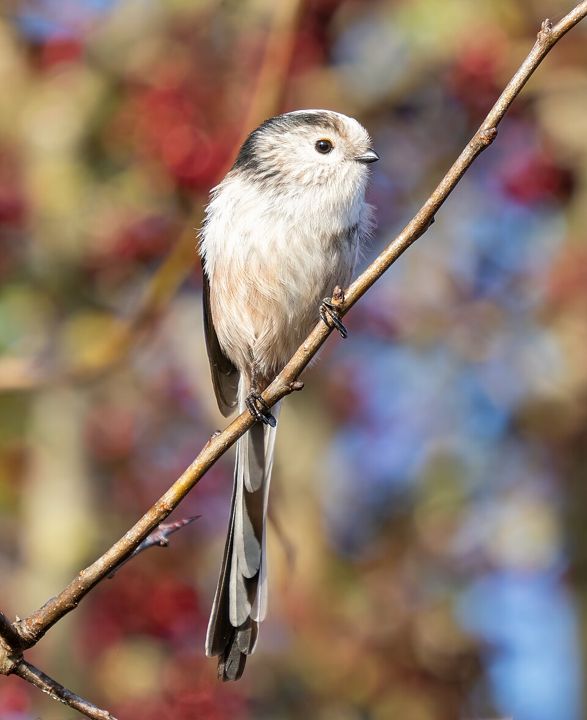
A tiny round ball of a bird, 13–15 cm long of which the tail is 7–9 cm, weighing about 8–9 g; a short stubby bill and a very long narrow tail. Mainly black and white with variable grey and pink. Northern subspecies, including the Hokkaido birds, are paler with wholly white heads, lacking the broad dark eyebrows of southern populations. Sexes alike; juveniles moult into adult plumage before their first winter.
Habitat
Deciduous and mixed woodland with a good shrub layer, also scrub, heath with scattered trees, farmland, riverside woods, parks and gardens; an insect-eater that lives in flocks all year, passing through the branches like beads on a string. The nest is woven from lichen, feathers, spider egg cocoons and moss.
Distribution
Widespread across temperate Europe and the Palearctic, from Scandinavia and Siberia to Kamchatka, Sakhalin, Japan, Mongolia, Korea and China's Xinjiang and north-east; in mountain conifer and mixed forest, common in the larch woods of eastern Liaoning, descending to the plains in winter. Common throughout Japan, the white-headed Hokkaido birds especially loved; absent from Singapore.
Season and behaviour
Resident, seen all year; in winter flocks of ten to fifteen move through the woods with thin tsee-tsee and trrr calls, often with tits. Nest-building from February to April.
Photography tips
These are the FilmAnalysis editors' notes, not content from the sources.
The flock passes fast and gives you two or three minutes: wait by a bare branch on their line of travel. The small white body overexposes in snow or overcast, so take off half a stop. The white-headed Hokkaido bird on a snowy twig is the classic picture; a long lens wide open blurs the branches. They are tiny, and even 600 mm is not long.
Field ethics: keep a distance at which the bird does not change its behaviour; never approach or publish nest sites; no baiting, playback or flash; never clear vegetation around a nest; follow reserve rules and stay on paths.
Photographic styles
White balls on snowy branches; high-key Japanese winter.
Similar species
The white-headed birds are this species' northern form; black-throated bushtit (chestnut crown, black throat, central and southern China); black-browed bushtit (south-western mountains).
Related badge
None yet. No validated photo recognition exists for this species, so no badge is tied to it: a name in the encyclopedia is not evidence in a photograph.
The illustration is original FilmAnalysis artwork. The photograph is from Wikimedia Commons; its licence and author are under it.