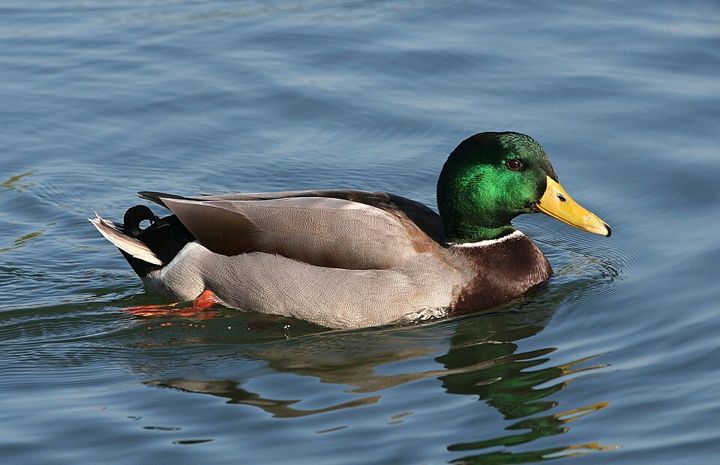
50–65 cm long, wingspan 81–98 cm, heavier than most dabbling ducks. The breeding male has a glossy bottle-green head, white collar, purple-tinged brown breast, grey-brown wings and pale grey belly, a black rear with curled tail feathers and a yellow-orange bill tipped black; the female is mottled brown with buff cheeks and brow and an orange bill marked with black. Both sexes have a white-bordered blue-purple speculum on the wing.
Habitat
Lakes, ponds, rivers, paddies and city park waters, eating water plants and small animals in sociable flocks. Introduced to New Zealand, Australia and South America.
Distribution
Breeds in temperate and subtropical North America, Eurasia and North Africa, wintering south to Mexico, North Africa and northern South Asia; one of the commonest winter ducks in China and Japan, with residents in Japan. Not found in Singapore.
Season and behaviour
Most numerous in eastern China and Japan from October to April; breeds in northern Japan. The drake's green head is brightest in winter and spring; in late-summer eclipse he looks like the female.
Photography tips
These are the FilmAnalysis editors' notes, not content from the sources.
The green head is a structural colour: it glows green and purple only in front or side light and goes black against the light, so get down to water level. Take-offs and landings need 1/2000 s for the spray. Tame park birds are good practice, but never bait them with food.
Field ethics: keep a distance at which the bird does not change its behaviour; never approach or publish nest sites; no baiting, playback or flash; never clear vegetation around a nest; follow reserve rules and stay on paths.
Photographic styles
Reflections and colour on water; winter ponds.
Similar species
Eastern spot-billed duck (both sexes like a female mallard, black bill with a yellow tip, common in China and Japan); females resemble female gadwall and pintail, told by speculum colour and bill.
Related badge
The album badge "a duck" unlocks when the vision model explicitly names a a duck in your photo and you rate the analysis. The badge stops at "a duck": it does not tell species apart, and this page existing unlocks nothing.
The illustration is original FilmAnalysis artwork. The photograph is from Wikimedia Commons; its licence and author are under it.