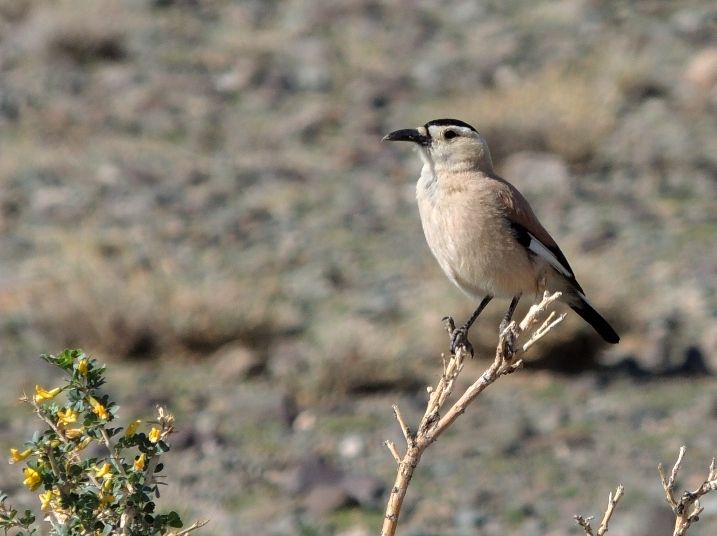
Photo: Vladimir Yu. Arkhipov, Arkhivov, via Wikimedia Commons, licensed CC BY-SA 3.0. Unmodified apart from resizing.
Region
Japan and temperate East Asia
Habitat
towns and gardens
Colour
brown, white, blue
Size
medium (20 to 50 cm)
IUCN status
Least Concern
IOC breeding range
PAL (n, e Xinjiang s through Qinghai and e to w Nei Mongol (nw, nc China) and w, s Mongolia)
Identification
28 cm long, averaging about 120 g. Sandy-beige upperparts, off-white breast, iridescent dark blue on the secondaries and primary tips; a long decurved bill and a black stripe on the forehead (black crown). Black tail, hence the Chinese name. Long-legged, running fast over the ground and reluctant to fly.
Habitat
Temperate desert: sparse saltbush and semi-shrub country, preferring gravel surfaces; nests in a bush, eats insects, seeds and small reptiles and caches food.
Distribution
The arid heart of Central Asia: western and southern Mongolia, northern and eastern Xinjiang and Qinghai to western Inner Mongolia in China, and adjacent Kazakhstan and Russia (type locality Yarkand, Xinjiang). Threatened by habitat loss and fragmentation. Absent from Japan and Singapore.
Season and behaviour
Resident, seen all year, most active running over the gobi at dawn; breeds from April to June.
Photography tips
These are the FilmAnalysis editors' notes, not content from the sources.
It runs across the gobi: follow slowly by car and wait for it to stop on a stone or bush top, then a front-lit long lens; the blue wing flashes only in the instant the wings open in front light, at 1/2000 s. A sand-coloured bird on sand needs shadow and outline, so the low light of morning and evening is best.
Field ethics: keep a distance at which the bird does not change its behaviour; never approach or publish nest sites; no baiting, playback or flash; never clear vegetation around a nest; follow reserve rules and stay on paths.
Photographic styles
A sand-coloured bird on gobi gravel; a flash of blue.
Similar species
Xinjiang ground jay (white tail, black cap, Tarim Basin only); other ground jays do not overlap.
Related badge
None yet. No validated photo recognition exists for this species, so no badge is tied to it: a name in the encyclopedia is not evidence in a photograph.
The illustration is original FilmAnalysis artwork. The photograph is from Wikimedia Commons; its licence and author are under it.