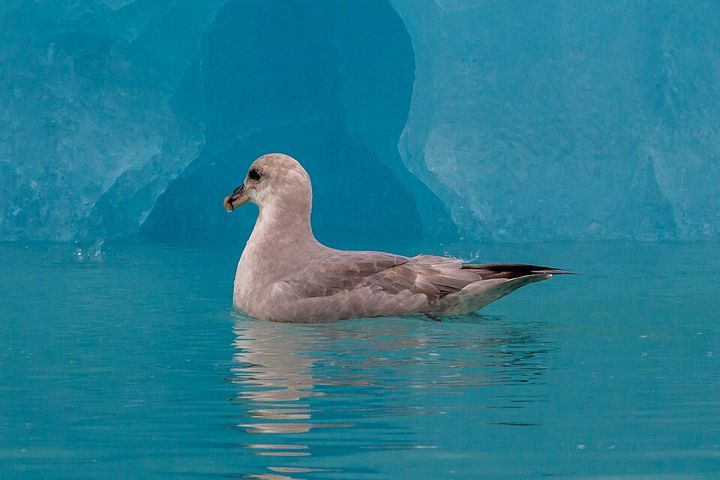
Photo: Original: AWeith; this edit: MPF, via Wikimedia Commons, licensed CC BY-SA 4.0. Unmodified apart from resizing.
Region
Japan and temperate East Asia
Habitat
coast and mangroves
Colour
grey, white
Size
medium (20 to 50 cm)
IUCN status
Least Concern
IOC breeding range
NA, PAL (is. and coasts of North Atlantic, bays between Arctic and North Atlantic, and North Pacific including Sea of Okhotsk and Bering Sea)
IOC non-breeding range
to coasts of nw Pacific s to Japan, ne Pacific s to Baja California (nw Mexico), w Atlantic s to North Carolina, e Atlantic s to France
Identification
Gull-like in appearance but a petrel: wingspan 102–112 cm, length 46 cm, 450–1,000 g. A short thick pale-yellow bill with tubular nostrils, bluish legs. Two colour morphs: the light morph of temperate populations with white head and body and grey wings and tail, and the dark morph of Arctic populations, uniformly grey, with intermediates in the Pacific. All show pale inner primaries on the upperwing. Stiff wings with an action unlike a gull's, and a bull-necked look. Long-lived, 31 years not uncommon.
Habitat
A subarctic seabird, at sea except when breeding; nests on sea-cliff ledges and spits stomach oil when threatened.
Distribution
Abundant in subarctic waters of the North Atlantic and North Pacific including the Sea of Okhotsk and Bering Sea; winters south to the Japanese coast, Baja California and North Carolina. Common in winter off northern and eastern Japan (Pacific birds mostly dark), a single record from China; absent from Singapore.
Season and behaviour
Off Japan's Pacific side from November to April, more off Hokkaido, often following fishing boats; breeds in the Kurils and elsewhere from May to September.
Photography tips
These are the FilmAnalysis editors' notes, not content from the sources.
From ferries and whale-watching boats: it glides close to the waves on stiff wings, so 1/2000 s, continuous focus and room ahead of its flight. Grey-blue sea and grey-white bird are one tone, so add half a stop. The tube nose shows only in a close side view; birds following the stern give the chance.
Field ethics: keep a distance at which the bird does not change its behaviour; never approach or publish nest sites; no baiting, playback or flash; never clear vegetation around a nest; follow reserve rules and stay on paths.
Photographic styles
Gliding between offshore waves; grey minimalism.
Similar species
Gulls (no tube nose, soft flapping flight); sooty and short-tailed shearwaters (dark brown, longer narrower wings).
Related badge
None yet. No validated photo recognition exists for this species, so no badge is tied to it: a name in the encyclopedia is not evidence in a photograph.
The illustration is original FilmAnalysis artwork. The photograph is from Wikimedia Commons; its licence and author are under it.