Elsewhere (in East Asia only in bird parks or botanic gardens)
Habitat
coast and mangroves
Colour
white, yellow, black
Size
large (over 50 cm)
IUCN status
Least Concern
IOC breeding range
AO (islands off subarctic, n temperate coasts of North Atlantic Ocean: Iceland, Faroe Is., British Isles, nw France and n Norway (e North Atlantic); Gulf of St. Lawrence and Atlantic coast of Newfoundland (se Canada, w North Atlantic))
IOC non-breeding range
to coastal e North Atlantic off sw Europe, w Mediterranean, Macaronesia s through Canary Is. (w of nw Africa) and nw Africa; to coastal w North Atlantic to Florida and n Gulf of Mexico
Identification
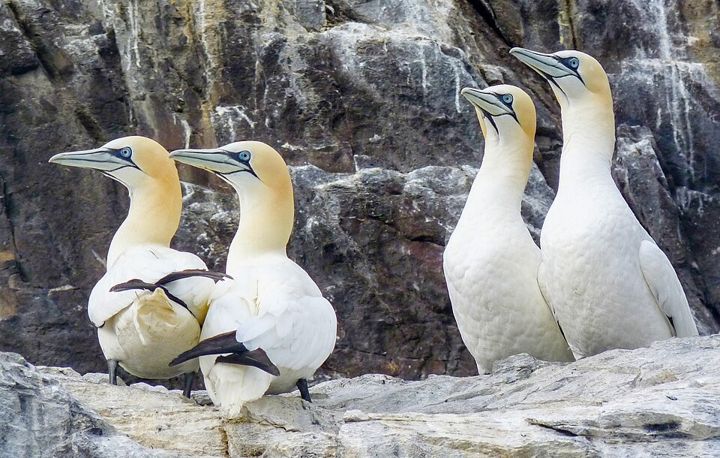
The largest gannet and the largest seabird of the North Atlantic: 87–100 cm long, wingspan 170–180 cm, 2.3–3.6 kg. A streamlined white body with a long neck and long slender wings tipped dark brown to black; the head and neck tinged buff-yellow, more so when breeding and deeper in males. Bare black skin round the eye, a cobalt-blue orbital ring and a light blue-grey iris. Sexes alike. Juveniles are dark brown with white specks and take five years to turn white.
Habitat
North Atlantic islands and sea cliffs, nesting in dense colonies; at sea it folds its wings and plunges from tens of metres for fish, one of the most spectacular feeding methods of any bird.
Distribution
Breeds in Western Europe and north-eastern North America: Iceland, the Faroes, the British Isles (Bass Rock is among the largest colonies), north-west France, northern Norway and the Gulf of St Lawrence; winters south to West Africa and the western Mediterranean. Absent from East Asia, and the Pacific has no gannet; Birdwatching Notebook lists it as an exotic.
Season and behaviour
At North Atlantic colonies from April to September; plunge-diving flocks can be seen near fishing grounds all year.
Photography tips
These are the FilmAnalysis editors' notes, not content from the sources.
The plunge is its signature: from a boat at 1/3200 s with continuous focus, aiming ahead of the moment the wings fold, with the column of spray as the second frame. Half a stop under for a white body over the sea. The packed colony on the cliff makes patterns with a long lens from a boat, and the buff head is truest in soft light.
Field ethics: keep a distance at which the bird does not change its behaviour; never approach or publish nest sites; no baiting, playback or flash; never clear vegetation around a nest; follow reserve rules and stay on paths.
Photographic styles
The instant of a plunge; dense white patterns on a sea cliff.
Similar species
Australasian and Cape gannets (southern relatives, no overlap); large gulls have a different wing shape and flight.
Related badge
None yet. No validated photo recognition exists for this species, so no badge is tied to it: a name in the encyclopedia is not evidence in a photograph.
The illustration is original FilmAnalysis artwork. The photograph is from Wikimedia Commons; its licence and author are under it.