PAL (widespread inland temperate and subarctic Eurasia: British Isles, Scandinavia and Baltic states to Iberian Pen. e through s, c Russia to se Russia and ne China, s through Turkey and Caspian region, Kazakhstan and Kyrgyzstan, Mongolia, and Xinjiang and Inner Mongolia (nw, nc China))
IOC non-breeding range
to n Africa, Arabian Pen., sub-Himalayan n Pakistan and n India, c, s Japan, Korean Pen., e China, Taiwan and n Vietnam
Identification
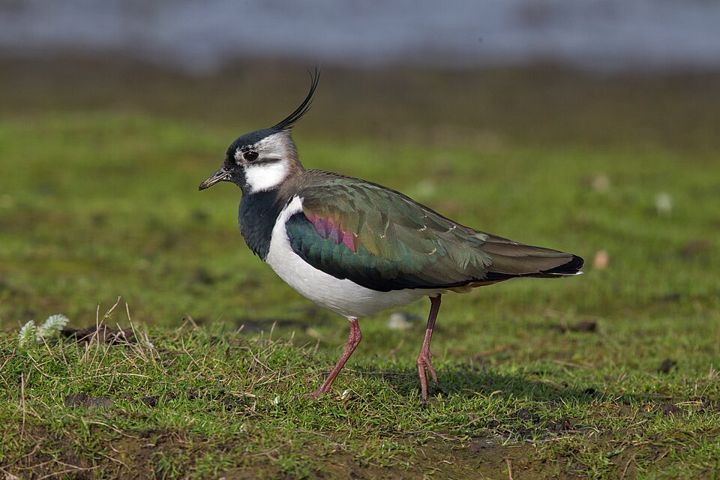
28–33 cm long, wingspan 67–87 cm, 128–330 g. Rounded wings, a long thin upturned crest, and the shortest legs of any lapwing. Mainly black and white with a green sheen on the back; the male has a long crest and black crown, throat and breast against a white face; females and young have shorter crests and less distinct head markings. In spring the male performs a tumbling display flight, calling pee-wit.
Habitat
Open farmland, wet grassland, harvested paddies, river beds and lake shores; lays in a scrape on the ground and winters in flocks.
Distribution
Breeds across temperate and subarctic inland Eurasia from the British Isles and Scandinavia to south-east Russia and north-east China; winters in North Africa, West Asia, northern India, central and southern Japan, Korea, eastern China, Taiwan and northern Vietnam. Common in winter on the farmland of the Yangtze basin and Japan.
Season and behaviour
In eastern China and Japan from October to March, in flocks on paddies and wetlands; breeds in north-east China from April to July. Winter flocks are wary and often rise together to circle.
Photography tips
These are the FilmAnalysis editors' notes, not content from the sources.
The green sheen appears only in front light, best in low winter afternoon sun; the raised crest wants a long lens and a side angle. When the flock rises, the flickering black-and-white wings make patterns at 1/2000 s. Waiting at a field edge in a car works far better than walking up.
Field ethics: keep a distance at which the bird does not change its behaviour; never approach or publish nest sites; no baiting, playback or flash; never clear vegetation around a nest; follow reserve rules and stay on paths.
Photographic styles
Black-and-white flocks on winter paddies; the detail of a metallic sheen.
Similar species
Grey-headed lapwing (grey head, no crest, yellow legs, common in China and Japan); no other lapwing has the long crest.
Related badge
None yet. No validated photo recognition exists for this species, so no badge is tied to it: a name in the encyclopedia is not evidence in a photograph.
The illustration is original FilmAnalysis artwork. The photograph is from Wikimedia Commons; its licence and author are under it.