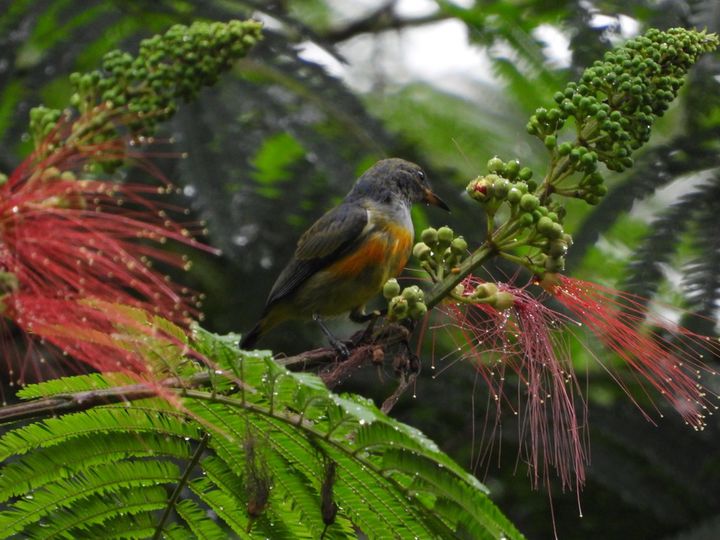
Photo: Светлана Царахова, via iNaturalist, public domain / CC0. Unmodified apart from resizing.
Region
Singapore and tropical Asia
Habitat
forest, coast and mangroves, towns and gardens
Colour
blue, orange, yellow, grey
Size
small (under about 20 cm)
Identification
A tiny bird, about 6.6 g on average. The male has slaty-blue crown, nape, wings and tail with a large triangular orange patch on the mantle; throat and upper breast pale grey-blue, then fiery orange on the lower breast grading to yellow at the vent. The bill is short, thin and slightly down-curved at the tip. The female is dull olive brown with a pale orange rump and yellow belly.
Habitat
Moist tropical lowland forest, mangroves and moist montane forest; also farmland, plantations and village gardens.
Distribution
Bangladesh, India, Myanmar, Thailand, Malaysia, Singapore, Brunei, Indonesia and the Philippines. Least Concern.
Season and behaviour
Not stated in the sources.
Photography tips
These are the FilmAnalysis editors' notes, not content from the sources.
Small and restless, it works the upper canopy of flowering and fruiting trees, often far away: 600 mm equivalent or longer, 1/1000 s or faster, continuous focus and a fast burst. Against the sky it turns into a silhouette, so add +1 to +1.7 EV; backlight makes the orange patch and belly glow.
Field ethics: keep a distance at which the bird does not change its behaviour; never approach or publish nest sites; no baiting, playback or flash; never clear vegetation around a nest; follow reserve rules and stay on paths.
Photographic styles
Bright blocks of colour; shallow-focus close-ups of a small bird.
Similar species
Scarlet-backed flowerpecker, same genus (the male is bright red from crown to back instead of blue-grey with an orange patch).
Related badge
None yet. No validated photo recognition exists for this species, so no badge is tied to it: a name in the encyclopedia is not evidence in a photograph.
The illustration is original FilmAnalysis artwork. The photograph is from iNaturalist; its licence and author are under it.
Why it is listed: this bird is named in the YouTube video description (波遊足跡 EP1) (the description text, not the subtitles). The video only shows that it was mentioned; names follow the IOC World Bird List 15.2 and the facts follow the sources below.