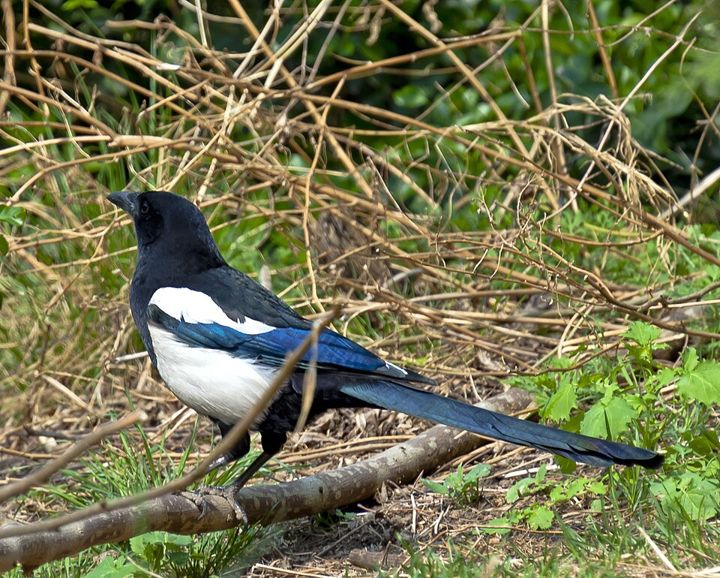
OR (se Russia and Myanmar to e China, Taiwan and n Indochina)
Identification
About 45 cm. Black head, breast and upperparts, white scapulars and belly, wings and tail with blue or green iridescence, the tail long and wedge-shaped. Slightly smaller than the Eurasian magpie, with a proportionally shorter tail, longer bill and legs and less white; the rump is mostly black with only a narrow greyish-white band joining the white shoulders. The call is the same as the Eurasian magpie's, somewhat softer.
Habitat
Villages, farmland, city parks, street trees and pylons, building a large domed stick nest high in a tree; omnivorous, striding over the ground to feed and unafraid of people.
Distribution
From south-eastern Russia and Myanmar to eastern China, Korea, Taiwan and northern Indochina; a naturalised population in Kyushu, Japan. One of the commonest large birds in the cities of northern and eastern China; absent from Singapore.
Season and behaviour
Resident, seen all year. Nest repair begins in late winter and breeding runs from March to May; in autumn and winter dozens roost together at dusk. The bird of good news in Chinese culture.
Photography tips
These are the FilmAnalysis editors' notes, not content from the sources.
High contrast: meter on the white shoulder and open up a little so the black keeps its shape; the blue-green sheen appears only in front or side light, never on a grey day. On a plum branch, in snow or before a red wall it is the traditional joy-on-the-eyebrows composition. The big nests show best in leafless winter trees.
Field ethics: keep a distance at which the bird does not change its behaviour; never approach or publish nest sites; no baiting, playback or flash; never clear vegetation around a nest; follow reserve rules and stay on paths.
Photographic styles
Strong black, white and blue; compositions from New Year prints.
Similar species
Eurasian magpie (north-west China and Xinjiang, more white, longer tail); azure-winged magpie (grey body, pale blue wings and tail, black cap, much smaller).
Related badge
The album badge "a magpie" unlocks when the vision model explicitly names a a magpie in your photo and you rate the analysis. The badge stops at "a magpie": it does not tell species apart, and this page existing unlocks nothing.
The illustration is original FilmAnalysis artwork. The photograph is from Wikimedia Commons; its licence and author are under it.