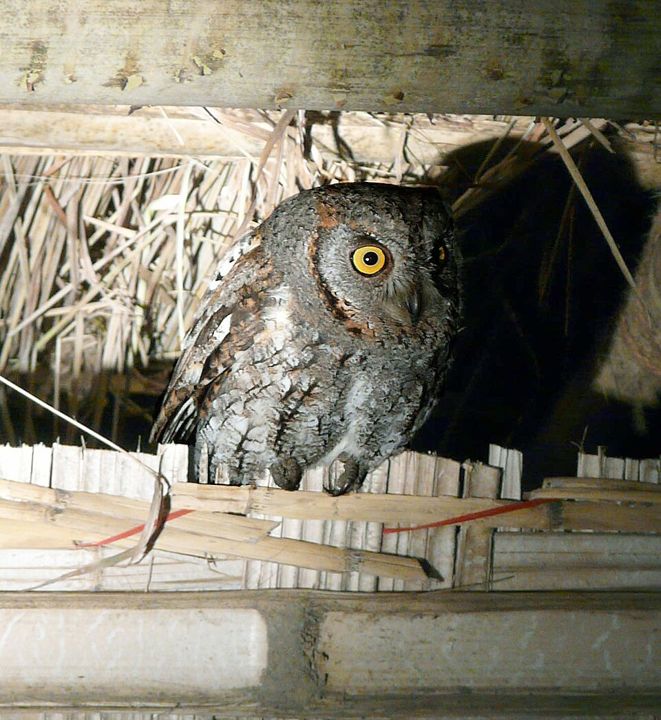
Photo: gailhampshire from Cradley, Malvern, U.K, via Wikimedia Commons, licensed CC BY 2.0. Unmodified apart from resizing.
Region
Japan and temperate East Asia, Singapore and tropical Asia
Habitat
forest
Colour
grey, brown, yellow
Size
small (under about 20 cm)
IUCN status
Least Concern
IOC breeding range
PAL, OR (widespread, also e Asia)
Identification
A small scops owl of variable plumage with yellow eyes and ear tufts that are not always raised. Grey and rufous morphs with intermediates. Told from the collared scops owl by a whitish scapular stripe, well-marked underparts and no pale collar. Sexes alike. When disturbed it freezes with half-closed eyes. The call is a repeated liquid tuk tok torok.
Habitat
Dry deciduous forest, open woodland, parks and old temple trees; nests in tree holes from February to April. Roosts by day pressed against a trunk, hidden by its plumage.
Distribution
Extremely widespread across eastern and southern Asia from the Russian Far East to Thailand; a summer visitor to eastern China and Japan, wintering in South-East Asia, and every passage season birds rest in Singapore's parks, a favourite of birders.
Season and behaviour
In eastern China and Japan from April to October, calling through summer nights in the woods; passage in Singapore in October–December and March–April. Daytime roosts in parks often draw a crowd.
Photography tips
These are the FilmAnalysis editors' notes, not content from the sources.
It does not move by day; the crowd is the problem. Stand back, use a long lens, stay no more than ten minutes, and never use flash or playback. Half-closed yellow eyes have no life, so wait for the moment it opens them naturally. Bark and plumage match almost exactly, so a wide aperture separates the background.
Field ethics: keep a distance at which the bird does not change its behaviour; never approach or publish nest sites; no baiting, playback or flash; never clear vegetation around a nest; follow reserve rules and stay on paths.
Photographic styles
Camouflage portraits in bark texture; muted grey-brown.
Similar species
Collared scops owl (larger, orange or brown eyes, pale collar); Sunda scops owl (dark eyes, tropics); Ryukyu scops owl (Ryukyus, different call).
Related badge
The album badge "an owl" unlocks when the vision model explicitly names a an owl in your photo and you rate the analysis. The badge stops at "an owl": it does not tell species apart, and this page existing unlocks nothing.
The illustration is original FilmAnalysis artwork. The photograph is from Wikimedia Commons; its licence and author are under it.