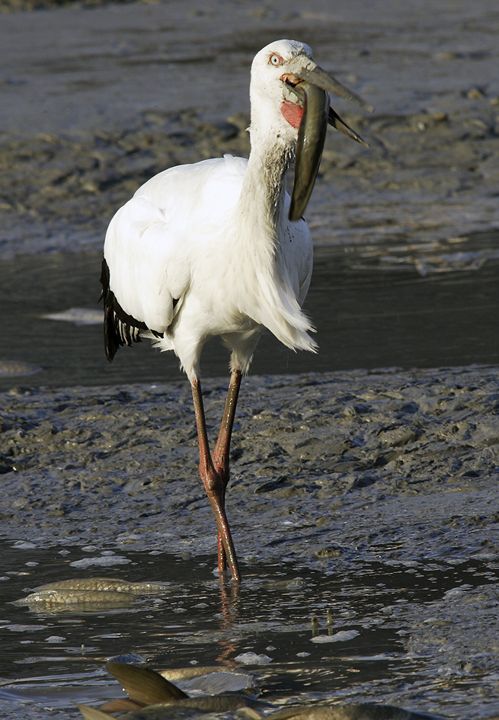
A large white stork with black flight feathers, 100–129 cm long, standing 110–150 cm, with a wingspan of about 2.2 m and weighing 2.8–5.9 kg, larger than the white stork. Unlike that species it has red skin around the eye, a whitish iris and a black rather than red bill; the legs are red. Sexes alike, the female slightly smaller; the young are white with orange bills.
Habitat
Open marshes, lakes, river beds, paddies and wet grassland, building a huge nest on tall trees, pylons and artificial platforms and eating fish, frogs and insects.
Distribution
Breeds in south-eastern Siberia and north-east China; the breeding populations of Korea and Japan were lost and are being reintroduced; winters in south-east China, with Poyang Lake the largest site. In May 2007 Japan's first wild-hatched chick in forty years was reported, from captive-bred parents, and reintroduction continues around Yesan in South Korea. A few thousand remain worldwide; endangered.
Season and behaviour
On the middle and lower Yangtze from November to March at Poyang, Dongting and coastal wetlands; breeds in north-east China from April to July, with many nests on pylons at Dongying and Tianjin. The released population at Toyooka, Hyogo, is present all year.
Photography tips
These are the FilmAnalysis editors' notes, not content from the sources.
At wintering sites such as Poyang, photograph feeding groups from a car with a long lens; the red eye-ring shows only close up in front light. The black-and-white wingspan in flight is spectacular at 1/1600 s; the big bird settling on a pylon or dead treetop at dusk is the classic picture. A first-class protected species: keep well away from nests.
Field ethics: keep a distance at which the bird does not change its behaviour; never approach or publish nest sites; no baiting, playback or flash; never clear vegetation around a nest; follow reserve rules and stay on paths.
Photographic styles
A great white bird on the wetland; the geometry of black-and-white wings.
Similar species
White stork (red bill, black around the eye, Europe and Central Asia); Siberian crane (all white with black primaries, but red face and short bill); Eurasian spoonbill much smaller, flat bill.
Related badge
None yet. No validated photo recognition exists for this species, so no badge is tied to it: a name in the encyclopedia is not evidence in a photograph.
The illustration is original FilmAnalysis artwork. The photograph is from Wikimedia Commons; its licence and author are under it.