Singapore and tropical Asia, Japan and temperate East Asia
Habitat
coast and mangroves, rivers and wetlands
Colour
brown, white
Size
large (over 50 cm)
IUCN status
Least Concern
IOC breeding range
Worldwide (widespread)
Identification
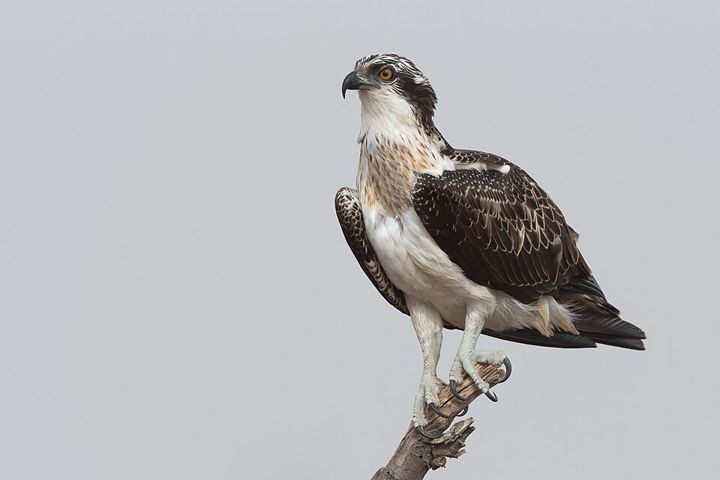
A large fish-eating raptor, 50–66 cm long with a wingspan of 127–180 cm. Brown above, mainly white on the head and underparts, with a dark stripe through the eye to the neck; the long narrow wings are held in an M in flight, white below with black carpal patches. The toes are equal in length, the outer one reversible, with rough soles for gripping slippery fish. The only species in its family.
Habitat
Any water with fish: coasts, estuaries, reservoirs, lakes and big rivers, nesting on tall waterside trees, pylons or platforms. It hovers high, then plunges feet first.
Distribution
Every continent except Antarctica; in South America only as a non-breeding migrant. Common on Japan's coasts and lakes, seen in winter on China's coasts and large inland waters, and recorded every winter at Singapore's reservoirs and shores.
Season and behaviour
All year in Japan; in eastern China and Singapore mainly September to April. After a catch it carries the fish head-forward back to a perch, a fixed habit.
Photography tips
These are the FilmAnalysis editors' notes, not content from the sources.
The hover, the folded dive and the shake on leaving the water need 1/2000 s and continuous focus, from the side it dives into the wind. The fly-past with a fish is best in front light; a reservoir on a clear morning is a good place. Keep well away from nests and use a long lens.
Field ethics: keep a distance at which the bird does not change its behaviour; never approach or publish nest sites; no baiting, playback or flash; never clear vegetation around a nest; follow reserve rules and stay on paths.
Photographic styles
Frozen action over open water; spray and light.
Similar species
White-bellied sea eagle (larger, white wedge tail, all-white belly without carpal patches); black kite (all brown, forked tail).
Related badge
None yet. No validated photo recognition exists for this species, so no badge is tied to it: a name in the encyclopedia is not evidence in a photograph.
The illustration is original FilmAnalysis artwork. The photograph is from Wikimedia Commons; its licence and author are under it.