Singapore and tropical Asia, Japan and temperate East Asia
Habitat
rivers and wetlands
Colour
brown, white, yellow
Size
medium (20 to 50 cm)
IUCN status
Least Concern
IOC breeding range
OR (widespread inland Pakistan to Luzon, Mindanao (n, s Philippines), Java and Bali)
IOC non-breeding range
OR : s through w Indonesia
Identification
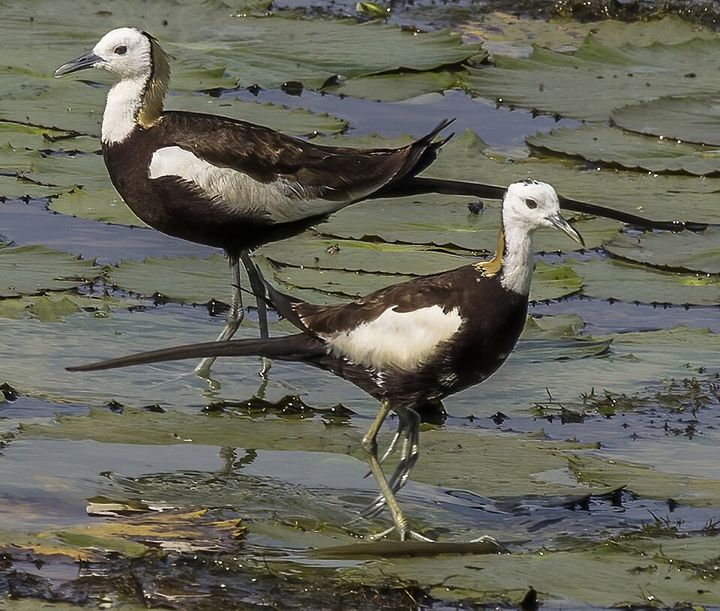
Conspicuous and unmistakable, the longest jacana once the tail streamers are counted. In breeding plumage the central tail feathers are greatly elongated; the body is chocolate brown, the face and foreneck white, the back of the crown black, with a white stripe down the neck side separating the white foreneck from the silky golden nape; the wings are almost all white with a black border in flight. Non-breeders have a dark brown crown and back, only a trace of the golden nape and a dark eye-stripe. The toes and claws are extremely long for walking on floating leaves.
Habitat
Shallow lakes, ponds and paddies with extensive floating vegetation, especially water chestnut, fox-nut and water-lily ponds, walking over the leaves for aquatic invertebrates and also swimming and wading. Polyandrous: the male incubates and raises the chicks.
Distribution
Tropical Asia from Yemen to the Philippines, inland from Pakistan to Luzon, Java and Bali; breeds on ponds south of the Yangtze and in the water-chestnut fields of south-west Taiwan, moving south in winter to Thailand, the Malay Peninsula and Indonesia. A few winter in Singapore; a vagrant to Japan.
Season and behaviour
In southern China and Taiwan in breeding plumage from May to September, the best season; most move south in winter, with some staying in the far south. Males guard chicks on the floating leaves and carry them under their wings.
Photography tips
These are the FilmAnalysis editors' notes, not content from the sources.
The long-tailed breeding plumage is best on water-lily ponds from June to August, when early backlight makes the golden nape glow and the tail reflects in the water. From a boat or a low bankside position let the floating leaves fill the foreground. Males with chicks need a quiet, distant lens; they are sensitive to disturbance.
Field ethics: keep a distance at which the bird does not change its behaviour; never approach or publish nest sites; no baiting, playback or flash; never clear vegetation around a nest; follow reserve rules and stay on paths.
Photographic styles
Ink-painting mood of lotus ponds and floating leaves; the line of the long tail.
Similar species
Bronze-winged jacana (similar out of breeding plumage but short-tailed, bronze wings, white brow); non-breeders resemble some rails but have the extremely long toes.
Related badge
None yet. No validated photo recognition exists for this species, so no badge is tied to it: a name in the encyclopedia is not evidence in a photograph.
The illustration is original FilmAnalysis artwork. The photograph is from Wikimedia Commons; its licence and author are under it.