AF, PAL (inland and coastal s British Isles, Iberian Pen., far s Scandinavia (nw to sw Europe) and sw Russia to Transbaikalia (ne Russia) and ne China s through n Middle East, c Asia to ec Afghanistan, Sind and Kutch (coastal Pakistan and nw India); e and s Africa)
IOC non-breeding range
to coastal n Africa, inland w Africa, Indian Pen., Sri Lanka, c Myanmar, c Thailand, and e China
Identification
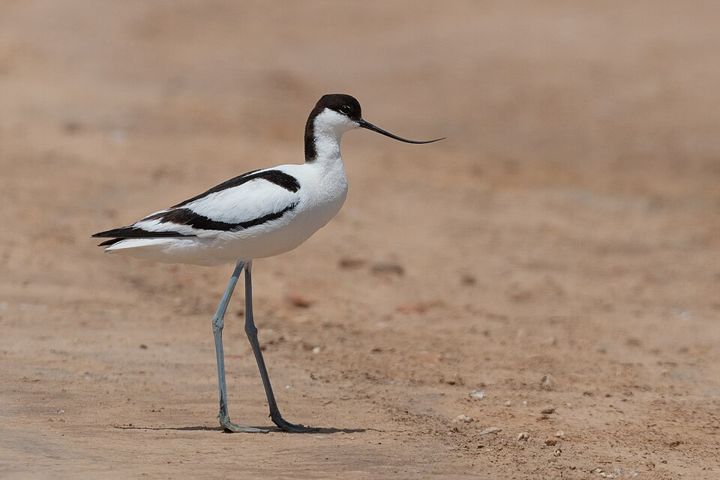
About 43 cm long with a wingspan of about 70 cm. Striking black and white: black cap running down the hindneck, black primaries and shoulders, the rest white; the long slender black bill is upturned, its unique mark; long bluish legs extend beyond the tail in flight. The male's bill is longer and straighter and his iris reddish; the female's bill shorter and more curved. It feeds by sweeping the bill side to side in the shallows.
Habitat
Coastal lagoons, salt pans, estuary mud and inland saline lakes, nesting colonially on open mud or islets; winters in large flocks sweeping the shallows.
Distribution
Europe, Africa and Asia, breeding from southern Britain, Iberia and southern Scandinavia to south-west Russia, Transbaikalia and north-east China and south to the northern Middle East; winters on North African coasts, inland West Africa, India, Sri Lanka, Myanmar, Thailand and eastern China. Breeds in northern China and winters south of the Yangtze and on the south-east coast; a scarce winter visitor to Japan; absent from Singapore.
Season and behaviour
In eastern China from October to March in flocks on salt pans and estuaries, breeding on the Bohai coast from April to July. Alarmed flocks rise together, black-and-white wings flickering.
Photography tips
These are the FilmAnalysis editors' notes, not content from the sources.
The upturned bill shows only in profile, so take side views, ideally with the reflection. A still salt pan at dawn is a mirror: from low down the pied bird and its reflection make a symmetrical figure. Sweeping flocks need 1/1600 s for the ripple at the bill tip. Stay out of colonies.
Field ethics: keep a distance at which the bird does not change its behaviour; never approach or publish nest sites; no baiting, playback or flash; never clear vegetation around a nest; follow reserve rules and stay on paths.
Photographic styles
Symmetrical reflections on salt pans; black-and-white line minimalism.
Similar species
Black-winged stilt (very long pink legs, straight bill, often together); no other pied wader has an upturned bill.
Related badge
None yet. No validated photo recognition exists for this species, so no badge is tied to it: a name in the encyclopedia is not evidence in a photograph.
The illustration is original FilmAnalysis artwork. The photograph is from Wikimedia Commons; its licence and author are under it.