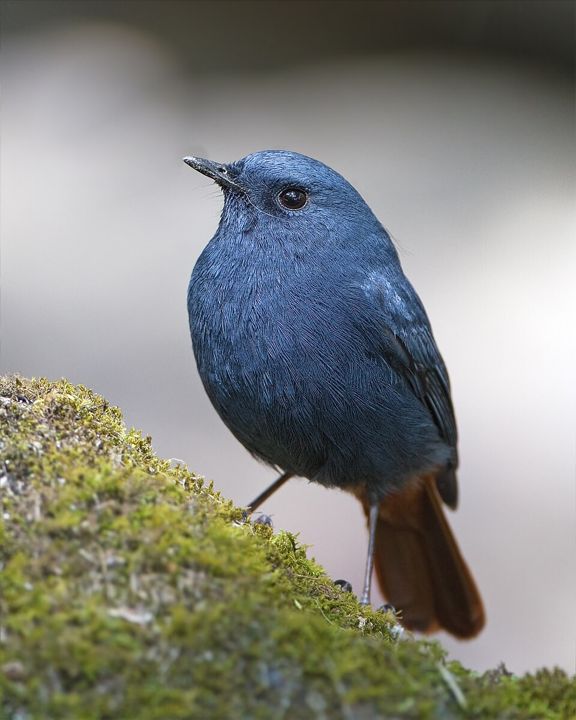
Photo: JJ Harrison (https://www.jjharrison.com.au/), via Wikimedia Commons, licensed CC BY-SA 3.0. Unmodified apart from resizing.
Region
Japan and temperate East Asia
Habitat
rivers and wetlands
Colour
blue, red, grey
Size
small (under about 20 cm)
IUCN status
Least Concern
IOC breeding range
OR (e Afghanistan to e China and Taiwan)
Identification
About 14 cm long, males averaging 22 g and females 18.8 g. The male is slate blue all over, the colour of lead, with a rusty-red tail; the female is pale grey with a white rump and a black-and-white tail. It stands on stream boulders constantly fanning and flicking its tail.
Habitat
Streams, gullies and rivers with shaded boulders and bankside vegetation, preferring streams rich in insects such as mayflies; Himalayan birds live between 2,000 and 4,100 m and descend in winter. Nests in rock crevices and under bridges.
Distribution
Afghanistan, Pakistan, India, Nepal, Bhutan, Bangladesh, Myanmar, Thailand, Laos, Vietnam and China, very common on hill streams from the south-west through central and eastern China to Taiwan. Absent from Japan and Singapore.
Season and behaviour
Resident, seen all year; a pair can almost always be found holding a stretch of any hill stream. Breeds from April to July; some descend in winter to lowland rivers and the streams of city parks.
Photography tips
These are the FilmAnalysis editors' notes, not content from the sources.
It stands on a mid-stream rock with moving water behind: at 1/15–1/60 s the water turns to mist while the bird stays sharp in its pause, with a tripod and patience; or at 1/1600 s catch the tail fanning. The male's blue colours only in soft front light, and the rusty tail is the accent.
Field ethics: keep a distance at which the bird does not change its behaviour; never approach or publish nest sites; no baiting, playback or flash; never clear vegetation around a nest; follow reserve rules and stay on paths.
Photographic styles
A blue bird on stream rocks over misted water; slow-shutter gorges.
Similar species
White-capped redstart (black with a white crown and a chestnut tail tipped black, on the same streams); rufous-tailed robin and female Daurian redstart (not on mid-stream boulders).
Related badge
None yet. No validated photo recognition exists for this species, so no badge is tied to it: a name in the encyclopedia is not evidence in a photograph.
The illustration is original FilmAnalysis artwork. The photograph is from Wikimedia Commons; its licence and author are under it.