Elsewhere (in East Asia only in bird parks or botanic gardens)
Habitat
coast and mangroves
Colour
black, white
Size
medium (20 to 50 cm)
IUCN status
Least Concern
IOC breeding range
NA, PAL (low Arctic to n temperate North Atlantic coasts: Greenland, Iceland, British Isles to Scandinavia, nw France and the White Sea (nw Russia), ne Canada to Gulf of Maine)
IOC non-breeding range
to Gulf Stream off North Carolina (w North Atlantic); to Iberian Pen. (e North Atlantic) and w Mediterranean Sea
Identification
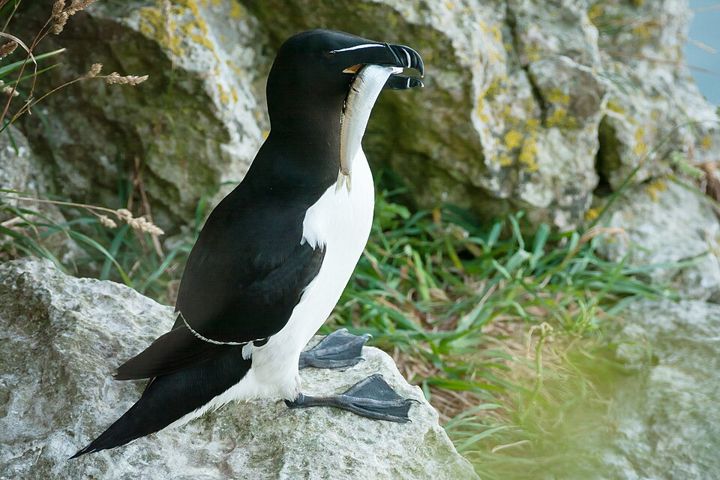
The only living species of its genus and the closest relative of the extinct great auk. In the breeding season black on the head, neck, back and feet with a white belly and a thin white line from the eye to the tip of the bill; the bill black, deep and laterally compressed with a blunt end and several vertical grooves near the curved tip, one marked with a broken white line. In winter the throat and face behind the eye turn white. 37–39 cm long, 505–890 g, darker-headed than the common murre. Sexes alike.
Habitat
Breeds colonially on North Atlantic sea cliffs and islands, laying a single egg in a crevice or under boulders; at sea the rest of the year, diving for capelin, sandeels, cod and herring.
Distribution
Confined to the North Atlantic: from the north-eastern United States and Canada to Greenland, and Iceland, the British Isles, Ireland, Scandinavia and north-west France to the White Sea, most in Iceland and Britain; winters south to the seas off North Carolina, Iberia and the western Mediterranean. Absent from East Asia; Birdwatching Notebook lists it among the exotic coastal-cliff birds.
Season and behaviour
At North Atlantic colonies from April to July, with Látrabjarg in Iceland and the Scottish sea cliffs the places to watch; at sea in winter.
Photography tips
These are the FilmAnalysis editors' notes, not content from the sources.
At the edge of a breeding cliff they sit close to the watcher, so a medium telephoto at eye level from the cliff top: the white line on the deep bill and the thin line to the eye are the point, clearest in side light. High contrast, so meter on the white belly and add half a stop. Mind the cliff edge and never cross a railing for an angle.
Field ethics: keep a distance at which the bird does not change its behaviour; never approach or publish nest sites; no baiting, playback or flash; never clear vegetation around a nest; follow reserve rules and stay on paths.
Photographic styles
Black-and-white geometry on sea cliffs; profile portraits of a deep bill.
Similar species
Common murre (thin pointed bill, browner head and back); thick-billed murre (heavy bill without grooves or white line).
Related badge
None yet. No validated photo recognition exists for this species, so no badge is tied to it: a name in the encyclopedia is not evidence in a photograph.
The illustration is original FilmAnalysis artwork. The photograph is from Wikimedia Commons; its licence and author are under it.