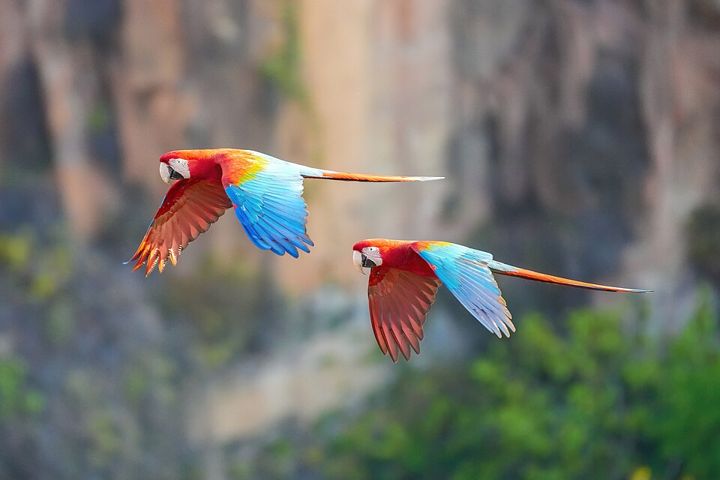
The largest of the Ara macaws, 90–95 cm long in adults, second in length only to the hyacinth macaw. Mostly bright red with green upper-wing coverts (yellow in the scarlet macaw), blue flight feathers and tail tips, and iridescent teal in the tail surrounded by red; the bare white face carries red lines of tiny feathers, the clearest difference from the scarlet macaw. A huge powerful bill, pale above and black below.
Habitat
Lowland rainforest and forest edge, in places to 1,500 m; eats fruit, seeds and nuts and visits clay licks, probably to neutralise toxins in its food.
Distribution
Native to Amazonia and south-central South America. In East Asia, Singapore and China it is seen only as a cage, zoo and bird-park bird; in Birdwatching Notebook it is a collectable exotic. Common in Japanese zoos and bird parks. The second most commonly kept macaw.
Season and behaviour
Seen all year at Singapore's bird park and similar places; in the wild a resident, breeding at the end of the rains. There is no wild population in East Asia; parks and free-flight shows are where it is met.
Photography tips
These are the FilmAnalysis editors' notes, not content from the sources.
Bird-park birds are tame and a medium lens is enough; red, green and blue stop fighting each other only in soft overcast light, and red bleeds in strong sun. The red face lines are what separate it from the scarlet macaw, so take the close-up. Open wings in a free-flight show need 1/2000 s. Label the picture as taken in a bird park, never as a wild record.
Field ethics: keep a distance at which the bird does not change its behaviour; never approach or publish nest sites; no baiting, playback or flash; never clear vegetation around a nest; follow reserve rules and stay on paths.
Photographic styles
Saturated primaries in a tropical garden; the great pattern of open wings.
Similar species
Scarlet macaw (yellow upper-wing coverts, no face lines, slightly smaller); blue-and-yellow macaw (blue back, yellow belly).
Related badge
None yet. No validated photo recognition exists for this species, so no badge is tied to it: a name in the encyclopedia is not evidence in a photograph.
The illustration is original FilmAnalysis artwork. The photograph is from Wikimedia Commons; its licence and author are under it.