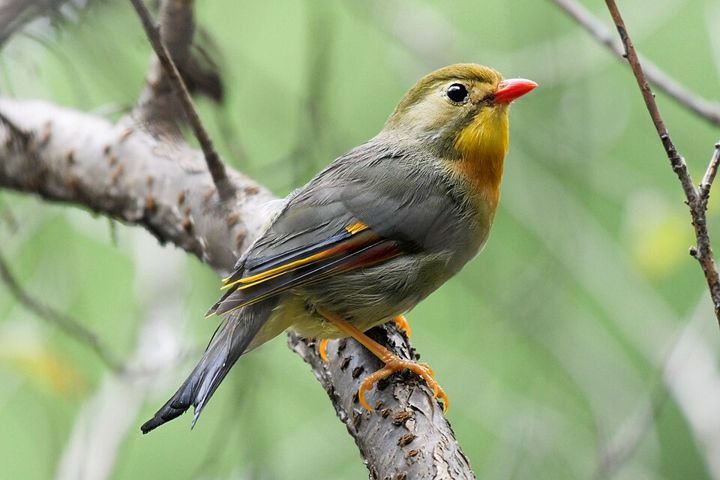
14–15.5 cm. Olive green overall with a yellow throat shading to orange on the breast and a yellowish-white ring round the eye running to the bill; the wing feathers are edged bright yellow, orange, red and black, and the forked olive-brown tail is blackish at the tip. Cheeks and neck sides bluish grey, eye brown, bill red, legs pinkish. Females are slightly smaller and duller with less red in the wing; juveniles duller still with a black bill. Very active and a fine singer, but secretive and hard to see.
Habitat
Evergreen broadleaf forest, secondary growth, bamboo and scrub in the hills, in flocks in the understorey, moving up and down the slopes with the seasons.
Distribution
Native to southern and eastern China and the Himalayas, common in the hills of southern and south-western China; feral populations from escaped cage birds have bred in the forests of western Honshu and Kyushu, Japan, since the 1980s, and it is introduced in Hawaii and elsewhere. Absent from Singapore.
Season and behaviour
Resident, seen all year, breeding higher up in summer and descending to the foothills in winter. Sings loudest from April to June, in pairs or small groups slipping through the undergrowth.
Photography tips
These are the FilmAnalysis editors' notes, not content from the sources.
It moves fast through understorey shade: high ISO, 1/800 s or faster, bursts, and ears before eyes, since you hear it long before it shows. The red bill and yellow throat need one shaft of side light against deep green. In winter they come down to drink and bathe in foothill scrub, and a waterside wait is the best plan.
Field ethics: keep a distance at which the bird does not change its behaviour; never approach or publish nest sites; no baiting, playback or flash; never clear vegetation around a nest; follow reserve rules and stay on paths.
Photographic styles
A point of red in deep green shade; a translucent small bird in Japanese style.
Similar species
Silver-eared mesia (silver ear patch, red in wings and tail base, south-west China and South-East Asia); Chinese hwamei (brown, white brow behind the eye).
Related badge
None yet. No validated photo recognition exists for this species, so no badge is tied to it: a name in the encyclopedia is not evidence in a photograph.
The illustration is original FilmAnalysis artwork. The photograph is from Wikimedia Commons; its licence and author are under it.