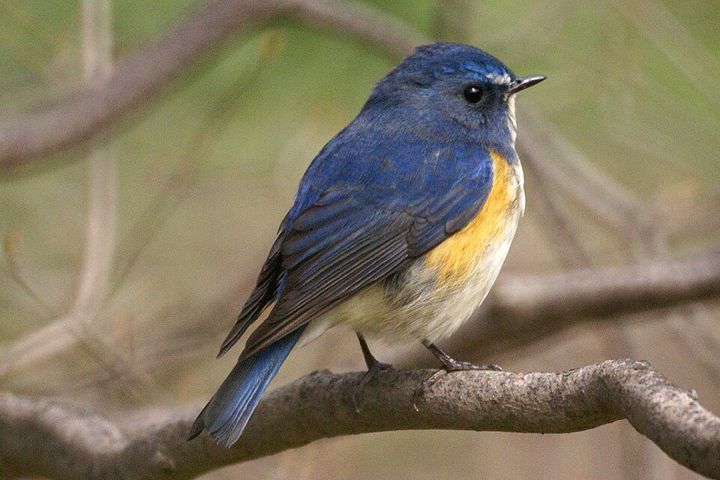
13–14 cm and 10–18 g, slimmer than a European robin. Both sexes have a blue tail and rump, orange-red flanks, a white throat and grey-white underparts, a small thin black bill and slender black legs. The adult male is dark blue above; females and young males are plain brown apart from the blue rump and tail, with a dusky breast. Like a redstart it flicks its tail constantly and sallies from a perch for insects in the air or on the ground.
Habitat
Breeds in mixed coniferous forest in northern Asia; in winter in the understorey of low hills and plains, bamboo, park scrub and gardens, keeping near the ground and quiet.
Distribution
Breeds across northern Eurasia from Finland to Japan; winters in South-East Asia, the Indian subcontinent, the Himalayas, Taiwan and northern Indochina. A common winter visitor to eastern China and Japan, with breeding birds in northern Japan; unrecorded in Singapore.
Season and behaviour
In eastern China and Japan from October to April, each bird holding a small winter territory in the undergrowth; males sing a melancholy trill from treetops and the call is a typical tacc.
Photography tips
These are the FilmAnalysis editors' notes, not content from the sources.
In winter it works the understorey at one or two metres in weak light: high ISO, a wide aperture, and 1/500 s to hold the pause after each tail flick. The male's blue goes grey in shade; one shaft of side light into the undergrowth lets blue and orange colour at once. Sit patiently at the edge of its territory and it returns to the same few perches.
Field ethics: keep a distance at which the bird does not change its behaviour; never approach or publish nest sites; no baiting, playback or flash; never clear vegetation around a nest; follow reserve rules and stay on paths.
Photographic styles
Blue and orange in low understorey light; Japanese winter tones.
Similar species
Golden bush robin (male with golden crown and brow, south-western mountains); bluethroat (blue throat, red tail base); females are told from female redstarts by the blue tail and orange flanks.
Related badge
None yet. No validated photo recognition exists for this species, so no badge is tied to it: a name in the encyclopedia is not evidence in a photograph.
The illustration is original FilmAnalysis artwork. The photograph is from Wikimedia Commons; its licence and author are under it.