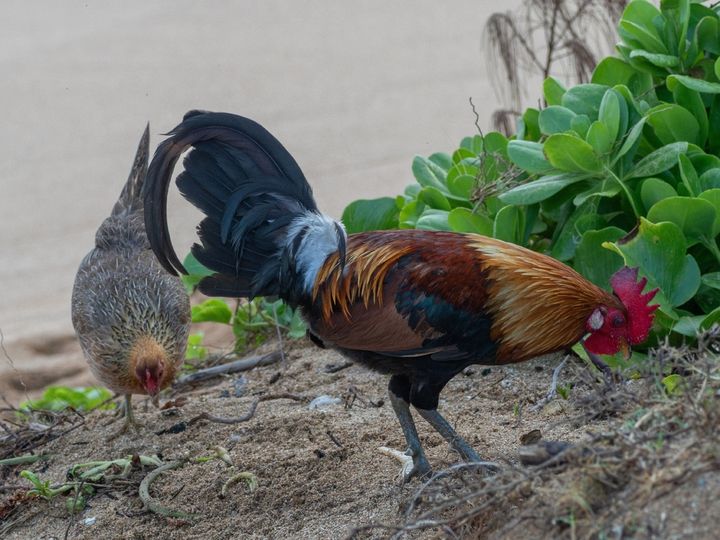
Photo: Eugene Eric Kim, via iNaturalist, public domain / CC0. Unmodified apart from resizing.
Region
Singapore and tropical Asia
Habitat
forest, towns and gardens
Colour
red, orange, green, black
Size
large (over 50 cm)
Identification
Strongly dimorphic. The male has long golden hackles on the neck and back and 14 tail feathers that shimmer blue, purple and green in direct light; some are long and curved, up to 28 cm, and the whole bird reaches 70 cm and about 1.5 kg. The female, about 1 kg, is drab for camouflage and lacks the long tail. It is the main wild ancestor of the chicken, smaller and a stronger flier.
Habitat
Edges and disturbed habitats: secondary and regenerating forest, bamboo and areas near settlements; in places also tea and oil-palm plantations.
Distribution
Much of Southeast Asia and parts of South Asia; in China in Yunnan, southern Guangxi and Hainan.
Season and behaviour
Far shyer than chickens. Males announce themselves by crowing, which follows a circadian clock: when one crows at dawn, the others nearby follow. Only hens care for eggs and chicks. An eclipse moult around June lasts into October.
Photography tips
These are the FilmAnalysis editors' notes, not content from the sources.
Easiest at dawn when the males crow: wait at the forest edge. They are wary, so stay low, use cover and move slowly. The tail's sheen needs direct light, best from the side or slightly behind; midday sun oversaturates the red comb, so pull exposure down a little. 1/500 s or faster for walking birds.
Field ethics: keep a distance at which the bird does not change its behaviour; never approach or publish nest sites; no baiting, playback or flash; never clear vegetation around a nest; follow reserve rules and stay on paths.
Photographic styles
Saturated side-lit portraits; small scenes at the forest edge.
Similar species
Domestic chicken (larger, very variable plumage); green junglefowl of Java (greener plumage).
Related badge
None yet. No validated photo recognition exists for this species, so no badge is tied to it: a name in the encyclopedia is not evidence in a photograph.
The illustration is original FilmAnalysis artwork. The photograph is from iNaturalist; its licence and author are under it.
Why it is listed: this bird is named in the YouTube video description (波遊足跡 EP1) (the description text, not the subtitles). The video only shows that it was mentioned; names follow the IOC World Bird List 15.2 and the facts follow the sources below.