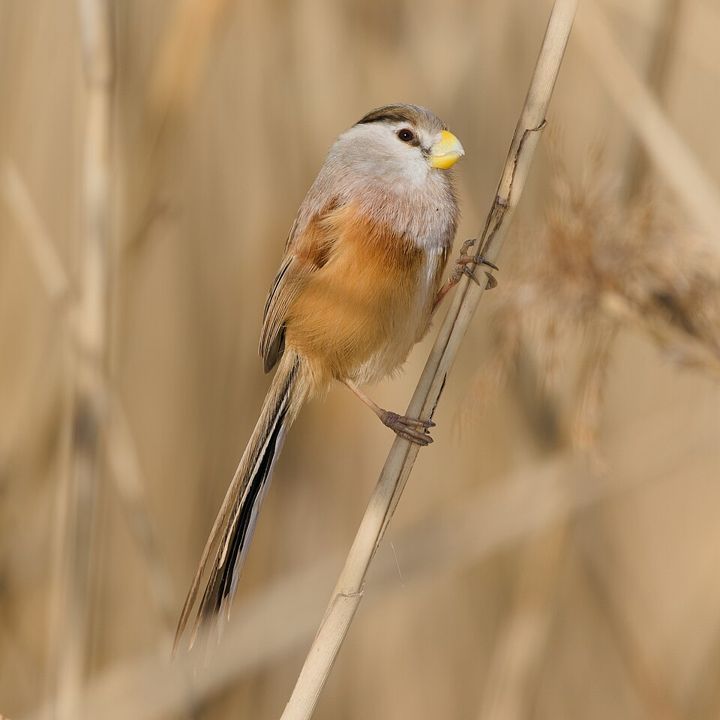
Photo: Sun Jiao (Interaccoonale), via Wikimedia Commons, licensed CC BY 4.0. Unmodified apart from resizing.
Region
Japan and temperate East Asia
Habitat
rivers and wetlands
Colour
brown, grey, yellow
Size
small (under about 20 cm)
IUCN status
Near Threatened
IOC breeding range
PAL (e Mongolia to e, ne China and se Russia)
Identification
A very short, wide and deep yellow bill like a parrot's; about 18 cm long with a long tail. In winter the forehead and neck are pinkish-cream and ash grey, with streaks of black and warm brown from above the eye to the crown, a whiter area between eye and bill, and a whitish stripe from the bill base over the eye to the back of the head; black and brown streaks down the body, blacker lower down. The only parrotbill whose appearance changes with the breeding season. Once placed in its own genus.
Habitat
Entirely dependent on reeds: large reed beds along rivers, lakes and coasts, clinging to the stems and splitting them open for the insects inside, with thin chattering calls. Reclamation and cutting of reed beds are its main threats.
Distribution
North-east China, the lower Yangtze (type locality Nanjing) and the Russian Far East, the northern subspecies sometimes split as a species; the reed wetlands of Chongming (Shanghai), Yancheng (Jiangsu), Tianjin and Liaoning are the places to see it. Absent from Japan and Singapore. Near threatened.
Season and behaviour
Resident, seen all year; easiest in winter when the reeds are yellow and the birds flock, often with bearded reedlings; breeds from May to July in a cup nest slung between reed stems.
Photography tips
These are the FilmAnalysis editors' notes, not content from the sources.
In winter its plumage matches the dead reeds, but the way it clings and splits stems is distinctive: wait at the edge of the bed with a long lens for one to climb to the top, 1/1000 s. The thick yellow bill is the focus. Walking into the reeds scatters the whole flock, so stay on the bund. In wind they hide low, so choose a still morning.
Field ethics: keep a distance at which the bird does not change its behaviour; never approach or publish nest sites; no baiting, playback or flash; never clear vegetation around a nest; follow reserve rules and stay on paths.
Photographic styles
A small bird on a reed stem; one tawny tone.
Similar species
Bearded reedling (male with black moustache, thin yellow bill, longer tail); vinous-throated parrotbill (small bill, unstreaked, brown head).
Related badge
None yet. No validated photo recognition exists for this species, so no badge is tied to it: a name in the encyclopedia is not evidence in a photograph.
The illustration is original FilmAnalysis artwork. The photograph is from Wikimedia Commons; its licence and author are under it.