PAL (lakes of ne Kazakhstan, Mongolia, Inner Mongolia and Shaanxi (nc China) and Transbaikalia (se Russia))
IOC non-breeding range
rare to coasts of Korean Pen., Bohai Bay, Yellow Sea and East China Sea
Identification
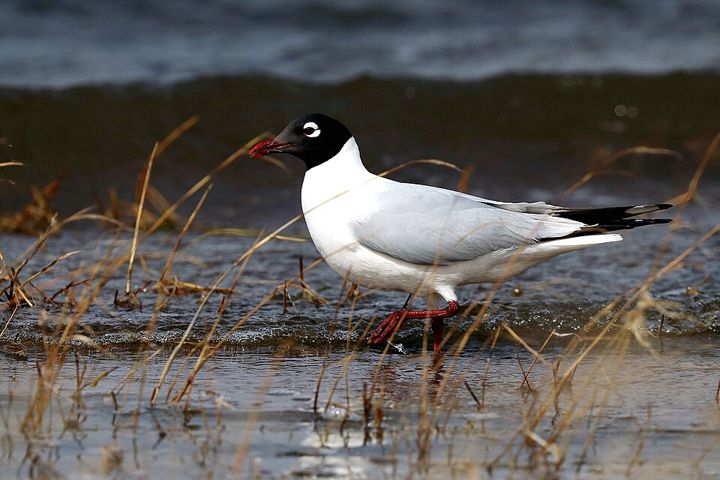
A medium-sized gull, 44–45 cm long with a stocky thick body. Breeding birds have a black hood including the nape, a grey-brown forehead and broad white half-moons behind, below and above the eye; orange legs and a scarlet bill. Non-breeders have uniformly dark-smudged ear coverts and hind crown, white-tipped wings, prominent isolated black subterminal marks on the outer primaries and no white leading edge to the outer wing. Until 1971 it was thought an eastern race of the Mediterranean gull.
Habitat
Breeds on islets in saline lakes of inland desert and steppe, where changing water levels make or break a whole colony; winters on coastal intertidal mud. The name comes from its status as a relict species.
Distribution
Breeds at several lakes in Mongolia, two in Kazakhstan, one in Transbaikalia in Russia and one in China (Hongjiannao, Shaanxi, once the largest colony; the Ordos lakes of Inner Mongolia have held big colonies too); winters on the Bohai Bay flats of Tianjin and Hebei and in Korea. Absent from Japan and Singapore. Endangered.
Season and behaviour
On the Bohai Bay coast from October to March, with thousands wintering on the flats at Beidagang and Hangu in Tianjin; breeds on inland saline lakes from April to July. The black hood comes in at the wintering grounds in March–April before departure.
Photography tips
These are the FilmAnalysis editors' notes, not content from the sources.
On winter flats they mix with black-headed gulls: look for the stockier bird with white wingtips and a smudged hind crown. In March, with the black hood coming in, it is easiest to pick out and best to photograph. The white eye crescents need close front light. Use a car and a long lens on the flats and stay off the mud; never land on a breeding islet.
Field ethics: keep a distance at which the bird does not change its behaviour; never approach or publish nest sites; no baiting, playback or flash; never clear vegetation around a nest; follow reserve rules and stay on paths.
Photographic styles
Grey-white winter flocks on the flats; portraits of black hood and white eye crescents.
Similar species
Black-headed gull (smaller and slimmer, white leading edge, brown hood); brown-headed gull (pale brown hood, white spots in black wingtips); Mediterranean gull (no range overlap).
Related badge
The album badge "a gull" unlocks when the vision model explicitly names a a gull in your photo and you rate the analysis. The badge stops at "a gull": it does not tell species apart, and this page existing unlocks nothing.
The illustration is original FilmAnalysis artwork. The photograph is from Wikimedia Commons; its licence and author are under it.