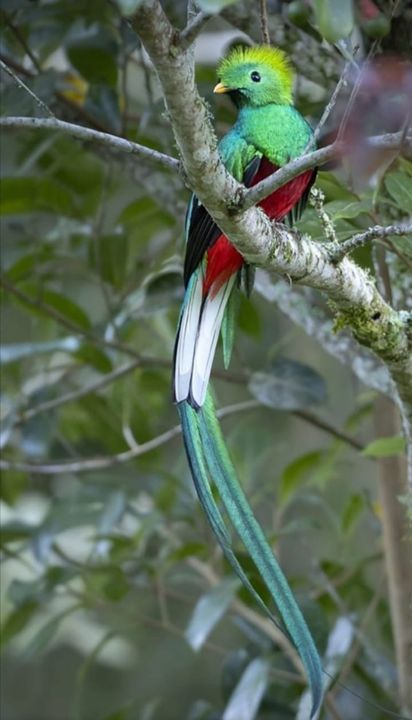
Elsewhere (in East Asia only in bird parks or botanic gardens)
Habitat
forest
Colour
green, red, white
Size
medium (20 to 50 cm)
IUCN status
Near Threatened
IOC breeding range
MA (s Mexico to w Panama)
Identification
The largest trogon, 36–40 cm long, the male's tail streamers of the nominate race 31–100.5 cm (median 75 cm), weighing about 210 g. Green body shifting with the light from green-gold to blue-violet, red lower breast and belly; the male's green uppertail coverts are hugely elongated and hide the tail, most splendid in breeding males, with a fluffy green crest. Important in Mesoamerican myth, the national bird of Guatemala, whose currency bears its name.
Habitat
Tropical montane cloud forest, nesting in a hole dug in a rotten trunk; feeds mainly on fruits of the laurel family and also insects, lizards, frogs and snails.
Distribution
The mountains of Central America from southern Mexico to western Panama, in two subspecies. Absent from East Asia and rarely kept in zoos (it does poorly in captivity); Birdwatching Notebook lists it as an exotic. Near threatened.
Season and behaviour
Resident, seen all year within its range; breeds from February to June, when the male's streamers are longest, and the cloud forests of Costa Rica are the most reliable place.
Photography tips
These are the FilmAnalysis editors' notes, not content from the sources.
Cloud-forest light is weak and diffuse, which suits its structural colour: high ISO, 1/500 s, and the bird facing the light. The long tail needs a portrait frame with space below. It feeds in fruiting wild avocado trees, and watching one tree beats searching. Keep away from nest holes and use no playback.
Field ethics: keep a distance at which the bird does not change its behaviour; never approach or publish nest sites; no baiting, playback or flash; never clear vegetation around a nest; follow reserve rules and stay on paths.
Photographic styles
Green and red in cloud forest; the hanging line of a long tail.
Similar species
Other trogons (uppertail coverts not elongated).
Related badge
None yet. No validated photo recognition exists for this species, so no badge is tied to it: a name in the encyclopedia is not evidence in a photograph.
The illustration is original FilmAnalysis artwork. The photograph is from Wikimedia Commons; its licence and author are under it.