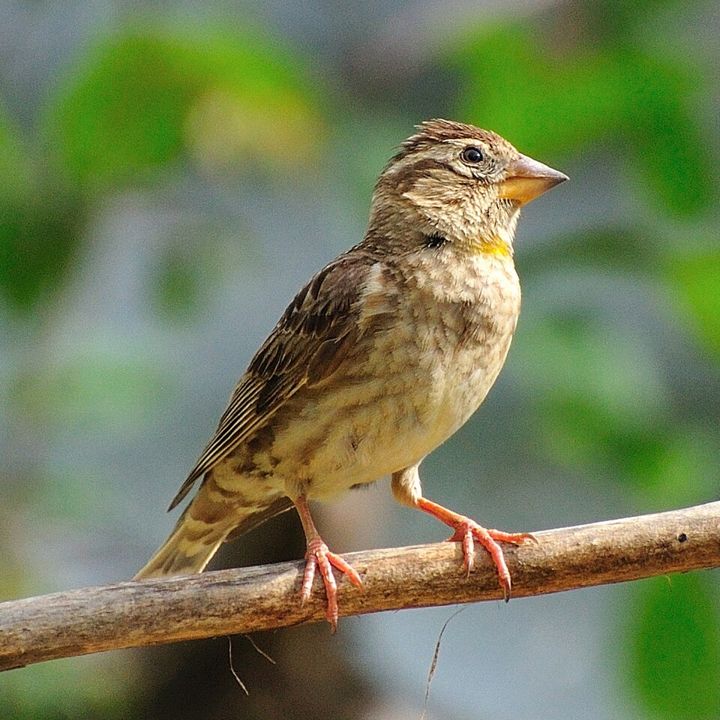
Photo: Sandra from France (derivative work: Snowmanradio), via Wikimedia Commons, licensed CC BY 2.0. Unmodified apart from resizing.
Region
Japan and temperate East Asia
Habitat
towns and gardens
Colour
brown, white, yellow
Size
small (under about 20 cm)
IUCN status
Least Concern
IOC breeding range
PAL (temperate to subtropical Palearctic in barren land, open groves and cultivation: Madeira and Canary Is. (c Macaronesia), Iberian Pen., sc France through Turkey, Caucasus, nw, se Kazakhstan, sc Russia and Mongolia to Inner Mongolia (ne China); in s from Morocco to nw Libya (nw, nc Africa), also Israel, w Jordan, n Iraq, s Iran and w Afghanistan through Tajikistan and Kyrgyzstan to nw Xinjiang, and Qinghai and Gansu s through Sichuan (nw China))
Identification
15–17 cm, slightly larger than a tree sparrow with a conspicuously larger, more conical bill. A strong whitish brow and weaker crown stripe, a patterned brown back and wings, streaked underparts, and a diagnostic but hard-to-see yellow throat spot carried by both sexes as a breeding signal. Otherwise almost monochrome earth-brown. A loud wheezy song.
Habitat
Barren rocky hills, open groves, cultivation and human settlements, nesting in holes in ruins and earth cliffs; gregarious.
Distribution
Breeds from Madeira and the Canaries, Iberia and western North Africa across southern Europe and through south-western and Central Asia to Mongolia and northern and western China (Xinjiang, Qinghai, Gansu, Inner Mongolia and elsewhere); resident in the west, with some Asian birds moving south or lower in winter. Absent from Japan and Singapore and rare in eastern China.
Season and behaviour
Breeds in north-west China from April to August and flocks in winter around fields and villages; seen all year around earth-cliff villages on the eastern Tibetan plateau.
Photography tips
These are the FilmAnalysis editors' notes, not content from the sources.
The yellow throat spot shows only when it lifts its head to sing, so wait for that moment with a long lens; the white brow is clearest in side light. It lives on earth cliffs and stone piles the same colour as itself, so it stands out only in front of a dark hole in shadow. Winter flocks on harvested fields can be approached slowly by car.
Field ethics: keep a distance at which the bird does not change its behaviour; never approach or publish nest sites; no baiting, playback or flash; never clear vegetation around a nest; follow reserve rules and stay on paths.
Photographic styles
A brown bird on earth cliffs and stone piles; the detail of a yellow throat.
Similar species
Eurasian tree sparrow (black cheek spot, small bill); female house sparrow (no white brow, no yellow throat); yellow-throated sparrows do not occur in China.
Related badge
None yet. No validated photo recognition exists for this species, so no badge is tied to it: a name in the encyclopedia is not evidence in a photograph.
The illustration is original FilmAnalysis artwork. The photograph is from Wikimedia Commons; its licence and author are under it.